Summary
In today’s fast-paced world, children are growing up in an environment where they are constantly exposed to comparisons, expectations, academic pressure, and social media influences. Whether it’s trying to fit in at school, achieving high grades, or comparing themselves with peers online, many children begin questioning their worth at an early age. This makes teaching self-acceptance more important than ever.
Self-acceptance is the ability to appreciate oneself’s strengths, weaknesses, mistakes, and all without relying on constant approval from others. Children who develop self-acceptance tend to have healthier self-esteem, greater emotional resilience, stronger relationships, and a more positive outlook on life. Rather than striving for perfection, they learn to embrace growth, celebrate progress, and recover more easily from setbacks.
The good news is that self-acceptance isn’t an inborn trait it’s a skill that can be nurtured through everyday experiences. Simple activities like celebrating small achievements, practicing gratitude, using positive affirmations, and expressing creativity can help children develop a healthy sense of identity and confidence.
In this article, we’ll explore ten engaging, evidence-based self-acceptance activities for kids that parents, teachers, and caregivers can use to help children build emotional strength, confidence, and lifelong resilience.
Introduction
Every child deserves to grow up believing one simple but powerful truth:
“I am enough just as I am.”
Yet for many children, this belief becomes difficult to maintain.
From a young age, children are often surrounded by comparisons. They may compare their appearance, talents, grades, athletic abilities, or friendships with others. Even well-meaning adults can unintentionally reinforce these comparisons by praising achievements more than effort or focusing on what children need to improve rather than what makes them unique.
Over time, children who constantly compare themselves with others may begin to believe that their worth depends on being the smartest, fastest, funniest, or most successful person in the room.
This is where self-acceptance becomes essential.
Teaching children to accept themselves doesn’t mean encouraging complacency or telling them they never need to improve. Instead, it means helping them understand that their value isn’t determined by perfection, popularity, or performance.
Children who accept themselves are more likely to:
- Try new experiences without fear of failure.
- Bounce back from mistakes.
- Develop healthy friendships.
- Express emotions openly.
- Feel confident in their own identity.
The earlier children learn self-acceptance, the stronger their emotional foundation becomes for adolescence and adulthood.
What Is Self-Acceptance?
Self-acceptance is the ability to recognize and appreciate yourself exactly as you are while also understanding that growth and improvement are lifelong journeys.
For children, self-acceptance means learning to say:
- “I made a mistake, but I can learn from it.”
- “I’m different from others, and that’s okay.”
- “I don’t have to be perfect to be loved.”
- “My strengths and weaknesses both make me unique.”
Rather than constantly seeking validation from others, children gradually develop confidence from within.
Self-acceptance differs from self-esteem.
While self-esteem often reflects how positively someone evaluates themselves, self-acceptance involves embracing oneself regardless of success or failure.
This makes self-acceptance a more stable and lasting foundation for emotional wellbeing.
Why Is Self-Acceptance Important for Children?
Children who develop self-acceptance are better equipped to handle life’s inevitable challenges.
Research in developmental psychology suggests that healthy self-acceptance contributes to:
Greater Emotional Resilience
Children recover more quickly after disappointments because they don’t see mistakes as reflections of their worth.
Higher Self-Confidence
Rather than avoiding difficult situations, self-accepting children are more willing to try new experiences and develop new skills.
Healthier Relationships
Children who appreciate themselves often find it easier to respect and appreciate others.
They are less likely to seek constant approval or engage in unhealthy comparisons.
Reduced Anxiety
When children stop believing they must be perfect, they often experience less pressure and greater emotional balance.
A Growth Mindset
Self-acceptance encourages children to view challenges as opportunities to learn rather than evidence of failure.
Signs Your Child May Be Struggling with Self-Acceptance
Every child experiences moments of self-doubt, but ongoing negative self-perception may indicate that additional support is needed.
Some common signs include:
- Frequently saying “I’m not good enough.”
- Comparing themselves with others.
- Fear of making mistakes.
- Avoiding new activities.
- Becoming overly upset by criticism.
- Constantly seeking reassurance.
- Negative self-talk.
- Difficulty accepting compliments.
Recognizing these signs early allows parents and caregivers to gently reinforce healthier ways of thinking.
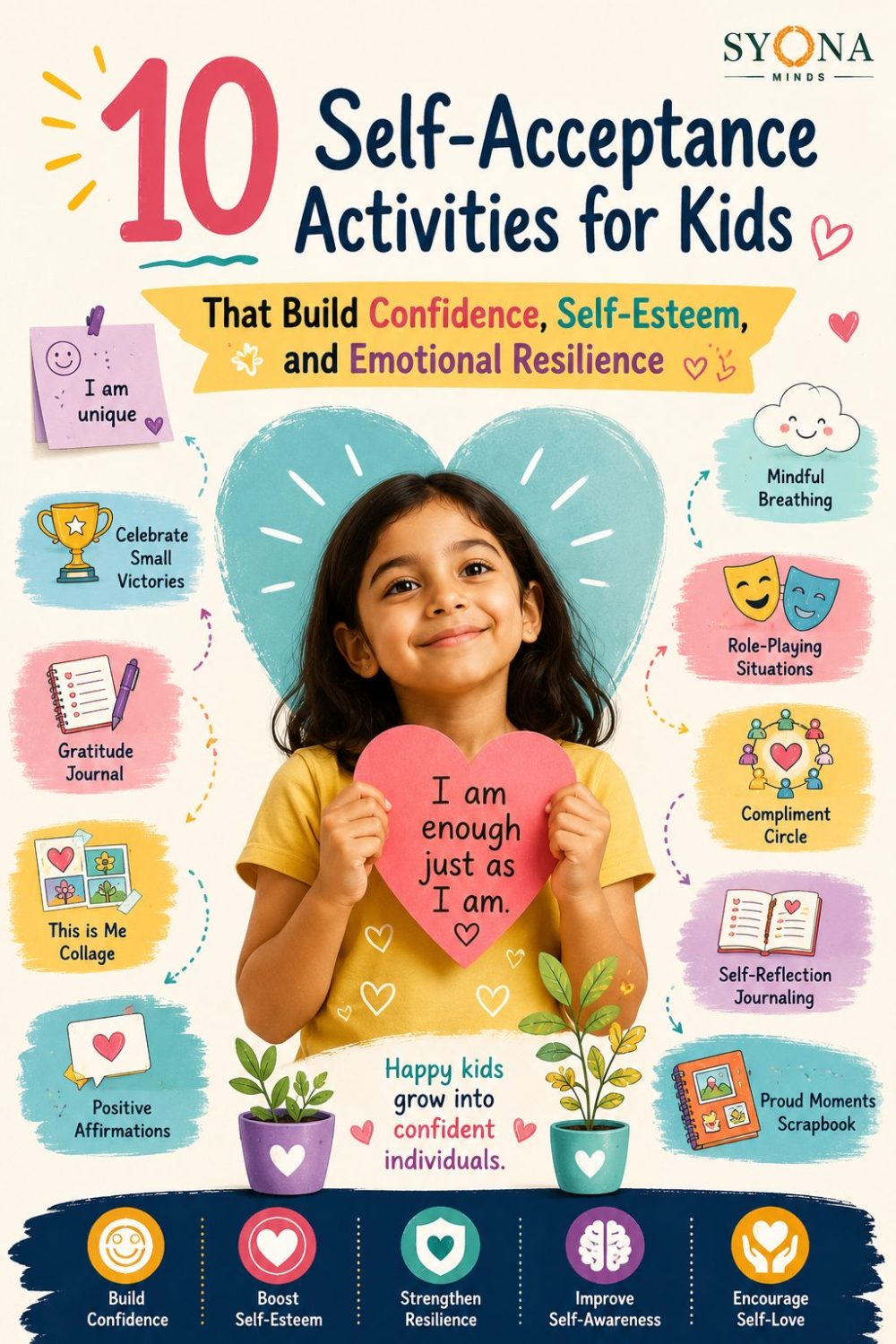
10 Self-Acceptance Activities for Kids
1. Celebrate Small Victories with a Victory Jar
Children often focus on what they haven’t achieved instead of recognizing their progress.
A Victory Jar helps shift their attention toward everyday successes. Place an empty jar somewhere visible at home.
Whenever your child accomplishes something big or small, invite them to write it on a colourful note and place it inside.
Examples include:
- Finished homework independently.
- Helped a sibling.
- Tried a new food.
- Practiced piano without reminders.
- Showed kindness to a friend.
- Learned a new word.
- Kept trying after making a mistake.
At the end of each week or month, read the notes together.
Why It Works
Celebrating small achievements teaches children that success isn’t limited to major accomplishments.
It reinforces progress, perseverance, and confidence.
Instead of constantly chasing perfection, children begin appreciating their everyday growth.
2. Create a “This Is Me” Collage
Creative expression allows children to explore their identity in fun and meaningful ways.
Provide:
- Old magazines
- Family photographs
- Colored paper
- Stickers
- Markers
- Craft supplies
Ask your child to create a collage that represents who they are.
Include:
- Favorite hobbies
- Talents
- Dreams
- Family
- Pets
- Favorite colors
- Positive personality traits
- Things that make them smile
Encourage them to explain their collage afterward.
Why It Works
Children begin recognizing that they are much more than grades, appearance, or achievements.
The collage becomes a visual reminder of everything that makes them unique.
3. Practice Positive Daily Affirmations
The way children speak to themselves gradually shapes how they see themselves.
Help your child develop positive self-talk through simple daily affirmations.
Examples include:
- I am kind.
- I am learning every day.
- I can solve problems.
- I am brave.
- I am loved.
- I believe in myself.
- My mistakes help me grow.
- I am enough.
Say affirmations together during:
- Breakfast
- The drive to school
- Bedtime
- Morning routines
Why It Works
Repeated positive statements gradually replace negative self-talk with healthier beliefs.
Children begin developing confidence from within rather than relying entirely on external praise.
4. Keep a Gratitude and Strength Journal
Gratitude helps children appreciate both their lives and themselves.
Instead of writing only what they’re thankful for, encourage them to record:
Three things they’re grateful for.
AND
One thing they did well that day.
Example:
Today I’m grateful for:
- Playing with my best friend.
- My favorite lunch.
- Reading with Dad.
Today I’m proud that:
- I helped someone at school.
Why It Works
This activity balances gratitude with self-recognition.
Children learn to appreciate both the world around them and the strengths they contribute to it.
5. Mindful Balloon Breathing
Mindfulness teaches children that emotions come and go and that difficult feelings don’t define who they are.
A simple breathing exercise works well for younger children.
Ask them to imagine:
Their stomach is a balloon.
As they breathe in…
The balloon slowly fills with air.
As they breathe out…
The balloon gently shrinks.
Repeat for five slow breaths.
You can also ask:
“What feeling came into your balloon today?”
“What feeling floated away?”
Why It Works
Mindful breathing helps children:
- Reduce anxiety.
- Calm their bodies.
- Become aware of emotions.
- Respond thoughtfully instead of reacting impulsively.
Over time, children learn that they can experience difficult emotions without judging themselves for having them.
6. Role-Playing Everyday Situations
Children often struggle with situations that challenge their confidence, such as introducing themselves to a new classmate, speaking in front of the class, handling criticism, or standing up to peer pressure. Role-playing allows them to practice these scenarios in a safe and supportive environment before facing them in real life.
Choose everyday situations your child may encounter, such as:
- Meeting a new friend
- Answering a teacher’s question
- Saying “no” to peer pressure
- Responding to teasing
- Making a mistake during a game
- Asking for help when needed
Take turns acting out different roles and encourage your child to think about how they would respond with confidence and kindness.
Why It Works
Role-playing helps children:
- Build confidence in social situations.
- Improve communication skills.
- Reduce anxiety about unfamiliar experiences.
- Develop healthy coping strategies.
- Learn that making mistakes is a normal part of life.
Rather than fearing difficult situations, children begin viewing them as opportunities to learn and grow.
7. Compliment Circle
Children often find it easier to compliment others than to recognise their own strengths. A Compliment Circle encourages both giving and receiving sincere appreciation. Sit together as a family, in a classroom, or in a small group. Each person gives one genuine compliment to the person beside them. Encourage compliments that focus on qualities rather than appearance.
Examples include:
- “I like how kind you are.”
- “You’re a great listener.”
- “I admire how you never give up.”
- “You always make people smile.”
- “You’re very creative.”
After everyone has received compliments, ask children:
“How did it feel to hear those kind words?”
Why It Works
Children learn that their value comes from their character, actions, and unique qualities rather than external achievements or appearance. This activity also strengthens empathy, kindness, and positive relationships.
8. Self-Reflection Journaling
Journaling gives children a private space to understand their thoughts, emotions, and experiences. Unlike a diary that simply records daily events, a self-acceptance journal encourages children to reflect on their personal growth.
Prompts might include:
- Something I did well today.
- Something that challenged me.
- A mistake I learned from.
- A quality I like about myself.
- Something kind I did for someone.
- One thing I want to improve tomorrow.
For younger children, drawing pictures instead of writing is equally effective.
Why It Works
Reflection helps children:
- Recognize personal growth.
- Understand emotions.
- Build self-awareness.
- Develop a healthier inner dialogue.
Over time, children begin focusing on progress rather than perfection.
9. Positive Body Appreciation Activity
As children grow, they become increasingly aware of appearance-based comparisons. Teaching them to appreciate what their bodies can do rather than how they look supports healthy body image and self-acceptance.
Ask your child to complete sentences like:
- “My legs help me…”
- “My hands help me…”
- “My eyes help me…”
- “I’m thankful my body lets me…”
Examples:
- Run with friends.
- Draw beautiful pictures.
- Hug people I love.
- Climb trees.
- Dance to my favorite songs.
Avoid conversations that focus on weight or appearance. Instead, celebrate strength, health, movement, and gratitude.
Why It Works
Children learn to value their bodies for their abilities rather than comparing themselves with unrealistic beauty standards.
This lays the foundation for lifelong body confidence and self-respect.
10. Create a “Proud Moments” Scrapbook
One of the most meaningful ways to reinforce self-acceptance is by helping children collect memories of their growth.
Create a scrapbook together using:
- Photos
- Certificates
- Drawings
- Tickets from special events
- Kind notes from teachers
- Artwork
- Stories about challenges they overcame
Include short reflections beside each memory, such as:
- “I was nervous, but I tried.”
- “I kept practicing until I learned.”
- “I helped someone today.”
- “I didn’t give up.”
Review the scrapbook together every few months.
Why It Works
Children often forget how much they have grown.
Looking back at their achievements reminds them that confidence develops through effort, courage, and persistence not perfection.
The scrapbook becomes a powerful reminder of who they are and how far they have come.
Common Mistakes Adults Make When Building Children’s Self-Esteem
Supporting self-acceptance requires more than offering praise. Sometimes, well-intentioned habits can unintentionally weaken a child’s confidence.
Comparing Children to Others
Statements like:
- “Why can’t you be more like your brother?”
- “Your friend got higher marks.”
may motivate temporarily but often increase self-doubt.
Instead, compare children only to their own previous progress.
Praising Only Achievements
Children need to know they are valued for who they are not just what they accomplish.
Rather than praising only grades or trophies, celebrate qualities like:
- Kindness
- Curiosity
- Honesty
- Creativity
- Persistence
- Responsibility
Expecting Perfection
Children who fear making mistakes often avoid trying new things.
Remind your child that mistakes are part of learning.
Use phrases such as:
- “What did you learn?”
- “Let’s try again.”
- “I’m proud that you kept trying.”
Solving Every Problem for Them
Rescuing children from every challenge may unintentionally reduce confidence.
Instead, guide them to think through solutions while offering support when needed.
Children build self-belief by overcoming manageable challenges independently.
Daily Habits That Encourage Self-Acceptance
Small daily interactions often have the greatest impact on a child’s self-image.
Try incorporating these habits into everyday life:
Model Self-Acceptance
- Children learn by observing adults.
- Avoid criticizing yourself in front of them.
- Instead, model healthy self-talk:
“I made a mistake, but I’ll learn from it.”
Listen Without Judgment
- Give children opportunities to express their feelings without immediately correcting or dismissing them.
- Feeling heard strengthens emotional security.
Celebrate Effort
- Recognize persistence more often than results.
- For example:
“You worked really hard on that project.”
instead of:
“You’re the smartest.”
Encourage Healthy Friendships
- Support relationships where children feel accepted, respected, and valued.
- Positive friendships reinforce self-worth.
Spend Quality Time Together
- Children feel more accepted when they receive undivided attention from trusted adults.
- Even 15–20 minutes of quality time each day can strengthen emotional connection.
Key Takeaways
✔ Self-acceptance helps children develop confidence, resilience, and emotional wellbeing.
✔ Everyday experiences have a powerful influence on how children view themselves.
✔ Activities like gratitude, journaling, affirmations, creative projects, and role-playing encourage healthy self-worth.
✔ Focus on effort, kindness, curiosity, and growth rather than perfection.
✔ Children learn self-acceptance best when adults model it themselves.
✔ Feeling accepted at home provides children with a strong foundation for lifelong emotional health.
Frequently Asked Questions (FAQs)
What is self-acceptance for children?
Self-acceptance is a child’s ability to appreciate and value themselves despite imperfections, mistakes, or differences. It helps children develop confidence, resilience, and a healthy sense of identity.
At what age can children begin learning self-acceptance?
Children can begin developing self-acceptance from a very young age. Simple activities like positive affirmations, celebrating effort, expressing emotions, and practicing gratitude can be introduced during the preschool years and adapted as children grow.
How is self-acceptance different from self-esteem?
Self-esteem refers to how positively a child evaluates themselves, while self-acceptance means embracing themselves regardless of success or failure. Self-acceptance provides a more stable emotional foundation because it isn’t dependent on achievements or external validation.
Can creative activities improve a child’s confidence?
Yes. Activities such as drawing, journaling, storytelling, role-playing, and creating personal scrapbooks encourage self-expression, creativity, and emotional awareness, all of which contribute to stronger self-confidence.
What should parents do if their child constantly compares themselves to others?
Avoid reinforcing comparisons and instead help your child focus on their own strengths, progress, and unique qualities. Celebrate effort, encourage gratitude, and remind them that everyone develops at their own pace.
Conclusion
Helping children develop self-acceptance is one of the greatest gifts parents, teachers, and caregivers can offer. In a world where children are constantly exposed to comparisons, expectations, and unrealistic standards, learning to appreciate themselves for who they are provides a powerful foundation for lifelong emotional wellbeing.
The activities in this article are more than fun exercises they are opportunities for children to discover their strengths, express their emotions, embrace mistakes, and recognize that their worth is not defined by grades, appearance, or achievements. Whether it’s celebrating small victories, creating a scrapbook of proud moments, practicing gratitude, or engaging in thoughtful conversations, each experience helps children build confidence from within.
Remember that self-acceptance develops gradually. It grows through consistent encouragement, unconditional love, and everyday moments where children feel seen, heard, and valued. Instead of striving to raise perfect children, we can aim to raise children who are kind to themselves, resilient in the face of challenges, and confident enough to embrace both their strengths and imperfections.
At Syona Minds, we believe every child deserves to grow up feeling accepted not because they are perfect, but because they are unique. By nurturing self-acceptance from an early age, we empower children to face life’s challenges with courage, compassion, and the confidence to become their authentic selves.
References
1. American Psychological Association. (2023). Developing Healthy Self-Esteem in Children.
2. Dweck, C. S. (2016). Mindset: The New Psychology of Success. Random House.
3. National Association for the Education of Young Children. (2024). Developmentally Appropriate Practice.
4. Siegel, D. J., & Bryson, T. P. (2016). The Whole-Brain Child. Bantam Books.
5. Seligman, M. E. P. (2011). Flourish: A Visionary New Understanding of Happiness and Well-being. Free Press.