Introduction
Abuse doesn’t always begin with shouting.
Sometimes, it begins with a sentence.
“You made me do it.”
“I’m only trying to help you.”
“You’ll understand when you’re older.”
These statements may sound familiar to many adults reflecting on their childhoods. On the surface, they can appear like ordinary parenting phrases. But when they are repeatedly used to excuse emotional manipulation, intimidation, humiliation, neglect, or physical violence, they become something much more damaging—they become tools of psychological control.
One of the most harmful aspects of toxic parenting isn’t just the abusive behavior itself. It’s the constant stream of excuses that convince children the abuse is normal, deserved, or even an act of love.
Children naturally trust their parents. When a parent repeatedly explains away harmful behavior, children rarely question the parent—they question themselves.
They begin to wonder:
- “Maybe I’m too sensitive.”
- “Maybe I deserved it.”
- “Maybe all parents are like this.”
Over time, these beliefs can shape how they view relationships, conflict, love, and even their own self-worth.
Modern psychology shows that childhood experiences have a profound impact on emotional development. Research on Adverse Childhood Experiences (ACEs) has found that ongoing emotional abuse, physical abuse, neglect, and chronic household dysfunction are associated with a higher risk of anxiety, depression, post-traumatic stress, relationship difficulties, substance misuse, and certain chronic health conditions later in life.
That doesn’t mean every child exposed to abuse will experience these outcomes. Many people demonstrate remarkable resilience, especially when they have access to supportive relationships and appropriate help. But it does highlight why abusive behavior—and the excuses that normalize it—should never be dismissed.
It’s equally important to recognize another truth:
Some abusive parents experienced trauma themselves.
Some struggle with overwhelming stress.
Others live with untreated mental health conditions or addiction.
These realities deserve compassion and support.
They do not justify abusing a child.
Understanding why abuse happens is different from excusing it.
In this article, we’ll examine ten of the most common excuses toxic parents use to justify abusive behavior, explain the psychology behind each one, and explore what healthy parenting looks like instead.
Why Do Toxic Parents Make Excuses?
Before examining these common statements, it’s important to understand why they happen.
Most abusive parents don’t think of themselves as abusive.
Instead, many unconsciously rely on psychological defense mechanisms to protect themselves from feelings of guilt, shame, or responsibility.
These defenses include:
- Denial
- Rationalization
- Projection
- Blame-shifting
- Minimization
- Gaslighting
These mechanisms reduce emotional discomfort for the parent—but they often increase confusion and emotional pain for the child.
For example, rather than admitting:
“I lost control.”
a parent may say:
“You forced me to react.”
Rather than accepting responsibility, the blame shifts onto the child.
Over time, children internalize these messages because they depend on their caregivers for survival.
This creates a painful belief:
“If I were a better child, my parent wouldn’t hurt me.”
This belief often persists well into adulthood.
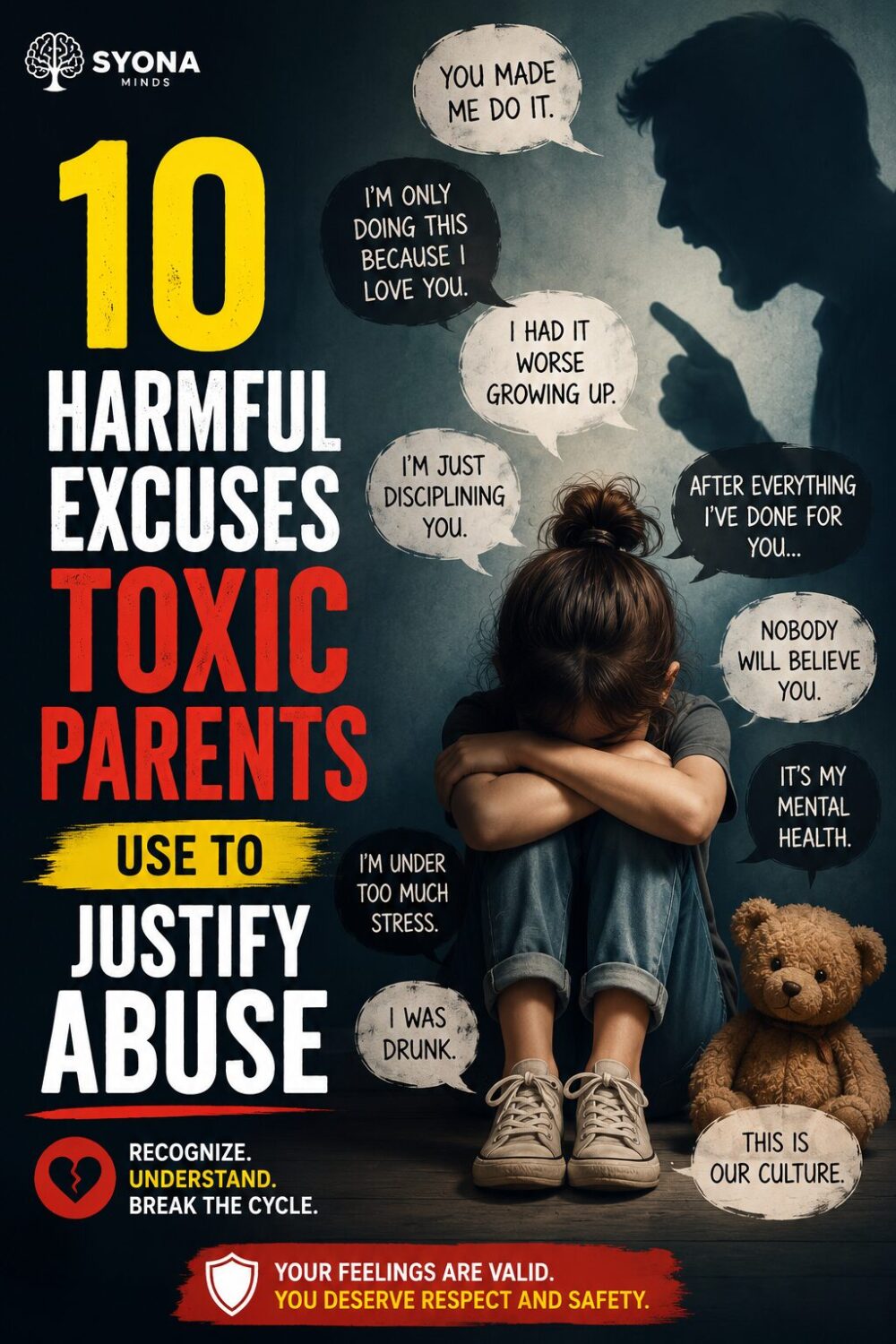
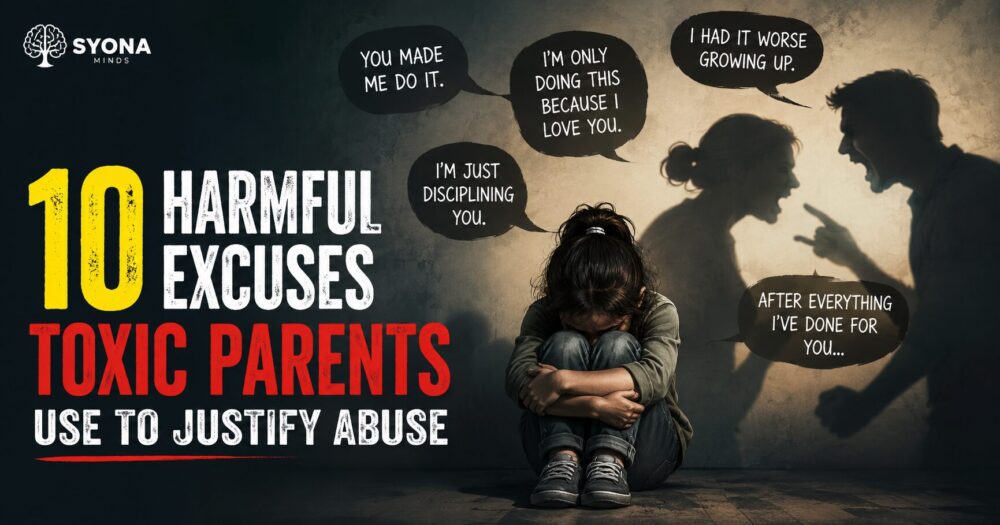
1. “You Made Me Do It.”
Perhaps the most common excuse abusive parents use is blaming the child.
Examples include:
- “If you had listened, I wouldn’t have yelled.”
- “Look what you made me do.”
- “You know exactly how to push my buttons.”
- “You deserved what happened.”
Although these statements sound like discipline, they teach children something dangerous:
Another person’s behavior is your responsibility.
Psychologists recognize this as blame-shifting, a manipulation tactic that allows the abusive person to avoid accountability.
Children cannot regulate an adult’s emotions.
Adults are responsible for managing their own reactions.
When children repeatedly hear they are responsible for adult anger, they often grow into adults who:
- constantly apologize
- fear conflict
- become people pleasers
- feel guilty for setting boundaries
- believe love must be earned
What Healthy Parents Do Instead
Healthy parents separate their emotions from their child’s behavior.
Instead of saying,
“You made me angry.”
they might say,
“I’m feeling frustrated, so I need a few minutes to calm down before we talk.”
This teaches emotional responsibility instead of emotional fear.
2. “I’m Only Doing This Because I Love You.”
Love should create safety.
Abuse creates fear.
When parents confuse the two, children begin associating control with affection.
Common examples include:
- “Everything I do is for your own good.”
- “This hurts me more than it hurts you.”
- “You’ll thank me someday.”
- “I’m protecting you.”
These statements aren’t automatically unhealthy.
Parents often make difficult decisions out of genuine concern.
The problem arises when these words are used to justify:
- emotional humiliation
- physical punishment
- intimidation
- excessive control
- manipulation
- threats
Children begin believing that pain is simply part of love.
As adults, they may tolerate controlling or abusive partners because those behaviors feel strangely familiar.
Psychologists sometimes refer to this as trauma bonding, where affection and fear become emotionally intertwined.
What Healthy Parents Do Instead
Healthy love protects without controlling.
It teaches rather than intimidates.
Healthy parents may enforce rules, but they do so while preserving the child’s dignity and emotional safety.
3. “I Had It Worse Growing Up.”
Intergenerational trauma is real.
Many parents who behave abusively experienced abuse themselves.
Some say:
- “My parents were much worse.”
- “You don’t know how lucky you are.”
- “I survived worse than this.”
- “At least I’m better than my father.”
While these statements may reflect genuine pain, they unintentionally dismiss the child’s experience.
Psychologists call this comparative suffering.
Instead of acknowledging harm, the parent redirects attention toward their own childhood.
This sends the message:
“Your pain doesn’t matter because mine was greater.”
Research suggests that unresolved childhood trauma can increase the risk of harsh parenting. However, many people who experienced difficult childhoods become compassionate, emotionally available parents.
Trauma increases vulnerability.
It does not determine someone’s future.
What Healthy Parents Do Instead
Emotionally healthy parents acknowledge both truths.
They can say:
“My childhood was difficult, and I’m working hard not to repeat those patterns with you.”
That response accepts responsibility instead of avoiding it.
4. “I’m Just Disciplining You.”
Discipline and abuse are often confused.
They are not the same.
Healthy discipline teaches.
Abuse controls.
Discipline asks:
“How can I help my child learn from this mistake?”
Abuse asks:
“How can I make my child obey me?”
Warning signs that discipline has crossed into abuse include:
- humiliation
- insults
- unpredictable punishments
- intimidation
- excessive fear
- physical violence
- emotional withdrawal
- withholding affection
Children learn best when they feel emotionally safe.
Fear may produce obedience in the moment, but it rarely teaches healthy decision-making or emotional regulation.
Healthy discipline focuses on guidance, consistency, natural consequences, and respectful communication.
5. “I’m Under Too Much Stress.”
Every parent experiences stress.
Long work hours, financial struggles, relationship conflicts, caregiving responsibilities, and health concerns can all leave parents emotionally drained. But stress should never become a license to mistreat a child.
Toxic parents often justify abusive behavior by saying:
- “I’ve had a terrible day.”
- “I’m overwhelmed.”
- “You don’t know what I’m dealing with.”
- “You pushed me too far.”
While these statements may explain a parent’s emotional state, they do not transfer responsibility for their actions.
From a psychological perspective, this excuse teaches children that they are responsible for managing adult emotions. Many children begin walking on eggshells, constantly monitoring a parent’s mood to avoid another outburst.
This pattern is known as hypervigilance—a survival response where a child becomes highly alert to emotional danger.
As adults, these children often:
- become chronic people-pleasers
- struggle to relax
- overanalyze conversations
- apologize excessively
- fear making mistakes
Instead of learning that adults regulate their emotions, they learn that their safety depends on keeping everyone else happy.
Healthy Parenting Looks Like…
Healthy parents acknowledge their emotions without making children responsible for them.
Instead of saying,
“You made me snap.”
they might say,
“I’m feeling overwhelmed. I need a few minutes to calm down before we continue this conversation.”
This models emotional regulation rather than emotional blame.
6. “It’s My Mental Health.”
Mental health conditions deserve compassion—not stigma.
Depression, anxiety disorders, bipolar disorder, PTSD, obsessive-compulsive disorder, and personality disorders can all affect how someone thinks, feels, and behaves.
However, mental illness does not automatically make someone abusive.
This distinction is extremely important.
Many toxic parents say:
- “I can’t help it.”
- “It’s because I’m depressed.”
- “My anxiety makes me like this.”
- “My trauma caused this.”
Mental illness may increase emotional dysregulation for some individuals, but it does not remove accountability.
Psychologists often distinguish between an explanation and an excuse.
An explanation sounds like:
“I’ve been struggling with my mental health, and I’m getting professional help because I don’t want it to affect my family.”
An excuse sounds like:
“That’s just how I am. Deal with it.”
One accepts responsibility.
The other avoids it.
The Hidden Impact on Children
Children often become caregivers instead of children.
They may suppress their own feelings because they believe their parent’s emotional needs matter more than their own.
This role reversal is known as parentification, where children take on emotional responsibilities that belong to adults.
Parentified children frequently grow into adults who struggle with:
- burnout
- perfectionism
- guilt
- difficulty asking for help
- unhealthy caregiving relationships
Healthy Parenting Looks Like…
Healthy parents seek support when their mental health affects family life.
They recognize that asking for help is a sign of strength—not weakness.
7. “I Was Drunk.”
Alcohol and substance use often appear in homes where abuse occurs.
After an incident, toxic parents may say:
- “I didn’t mean it.”
- “I wasn’t myself.”
- “I don’t even remember.”
- “The alcohol made me do it.”
Substances can lower inhibitions and impair judgment.
They can intensify aggression.
But they do not erase responsibility.
For a child, the emotional impact remains exactly the same.
Children don’t remember blood alcohol levels.
They remember fear.
Growing up with parental addiction often creates an environment of unpredictability.
One day a parent is affectionate.
The next day they’re angry, emotionally unavailable, or frightening.
Children never know which version of their parent they’ll encounter.
This unpredictability can lead to chronic stress, making it difficult to feel safe even in adulthood.
Long-Term Effects
Many adult children of parents with substance use disorders experience:
- trust issues
- fear of abandonment
- anxiety
- hypervigilance
- difficulty forming stable relationships
Healthy Parenting Looks Like…
Parents in recovery can rebuild trust—but it begins with accountability.
Statements such as:
“I hurt you, and I’m committed to changing.”
are far more healing than,
“That wasn’t really me.”
Recovery requires honesty, consistency, and sustained effort.
8. “This Is Just Our Culture.”
Culture influences parenting styles around the world.
It shapes family values, traditions, expectations, and discipline.
However, culture should never be used to justify abuse.
Some parents say:
- “This is how we were raised.”
- “Respect your elders.”
- “That’s our tradition.”
- “Everyone in this family was disciplined this way.”
While cultural norms deserve respect, they should not excuse behaviors that cause lasting psychological or physical harm.
Modern child development research consistently shows that children thrive when parenting is:
- emotionally responsive
- consistent
- respectful
- nurturing
- appropriately structured
Fear-based parenting may produce short-term obedience.
It rarely produces emotionally healthy adults.
Why This Excuse Is So Powerful
Many survivors struggle with guilt because they believe rejecting abusive behavior means rejecting their family or culture.
Psychology encourages a more balanced perspective:
You can appreciate your cultural identity while also recognizing that harmful behaviors deserve to change.
Healthy traditions strengthen families.
Abuse weakens them.
9. “Nobody Will Believe You.”
This is one of the most psychologically damaging excuses because it attacks a child’s sense of reality.
Parents may say:
- “Everyone thinks I’m a great parent.”
- “You’re lying.”
- “You’re imagining things.”
- “You’re too sensitive.”
- “Who do you think they’ll believe?”
This pattern is known as gaslighting.
Gaslighting involves manipulating someone into questioning their own memories, emotions, or perceptions.
Children are especially vulnerable because they rely on parents to understand the world around them.
Over time, they begin asking themselves:
- “Did that really happen?”
- “Maybe I’m exaggerating.”
- “Maybe I’m remembering it wrong.”
Many adults don’t recognize emotional abuse until years later because they were repeatedly taught to distrust themselves.
Healthy Parenting Looks Like…
Healthy parents may disagree with their children.
But they don’t erase their reality.
Instead they say:
“I remember things differently, but I want to understand how you experienced it.”
That response creates connection instead of confusion.
10. “After Everything I’ve Done for You…”
Perhaps the most emotionally manipulative excuse is the belief that children owe unconditional obedience because of parental sacrifice.
Common phrases include:
- “I sacrificed everything for you.”
- “You should be grateful.”
- “After all I’ve done…”
- “You owe me.”
Parents absolutely make sacrifices.
Raising children requires time, money, energy, and commitment.
But meeting a child’s basic needs isn’t a favor.
It’s a parental responsibility.
When love becomes transactional, children begin believing they must constantly earn affection.
As adults, they often struggle with:
- perfectionism
- fear of disappointing others
- low self-worth
- difficulty saying no
- guilt whenever they prioritize themselves
Healthy families don’t keep emotional scorecards.
Love isn’t a transaction.
It’s a relationship built on safety, respect, and care.
Healthy Parenting Looks Like…
Healthy parents appreciate gratitude—but they don’t demand it as payment for raising their children.
Instead of saying,
“You owe me.”
they communicate,
“I chose to become your parent because I love you, and caring for you is my responsibility.”
That message fosters security rather than obligation.
Key Takeaway
A common thread connects all ten excuses:
Each one shifts responsibility away from the parent and places it—directly or indirectly—on the child or on external circumstances.
Whether it’s stress, trauma, addiction, culture, or sacrifice, the message becomes:
“My behavior isn’t really my fault.”
From a psychological perspective, this is deeply harmful because it teaches children to doubt themselves, suppress their emotions, and normalize unhealthy relationships.
Recognising these excuses isn’t about encouraging blame or resentment. It’s about helping survivors separate explanations from justifications. A parent’s hardships may explain why abusive patterns developed, but they do not erase the harm or remove the responsibility to change.
The Long-Term Psychological Effects of Growing Up With Toxic Parents
Childhood doesn’t end when we become adults.
The lessons we learn from our caregivers often shape how we think, feel, communicate, and build relationships for decades. When a child grows up hearing excuses that normalize abuse, the emotional wounds may persist long after the events themselves.
Psychologists often describe childhood as the foundation of emotional development. A parent’s words become a child’s inner voice. Their reactions become the child’s model for handling conflict, affection, and self-worth.
Not every survivor experiences the same long-term effects, and many people heal and build fulfilling lives. However, research consistently links chronic childhood adversity with increased risks for emotional, relational, and physical health challenges.
Here are some of the most common long-term effects.
Low Self-Esteem and Chronic Self-Doubt
Children naturally trust what their parents tell them.
If they’re repeatedly called:
- “lazy”
- “selfish”
- “dramatic”
- “too sensitive”
- “a disappointment”
they often begin believing these labels are facts rather than opinions.
Many adults raised by toxic parents continue criticizing themselves with the same words they heard as children.
Instead of asking,
“Was I treated unfairly?”
they ask,
“What’s wrong with me?”
Hypervigilance
Children raised in unpredictable households often become experts at reading emotional cues.
They notice:
- facial expressions
- footsteps
- voice changes
- silence
- body language
because these signals helped them anticipate danger.
While this skill may have protected them in childhood, it often becomes exhausting in adulthood.
Many survivors report feeling constantly “on edge,” even in safe environments.
Difficulty Trusting Others
When the people meant to provide safety repeatedly cause harm, trusting others becomes difficult.
Some survivors avoid closeness altogether.
Others become overly dependent in relationships because they fear abandonment.
Both responses are understandable adaptations to early attachment wounds.
People-Pleasing
Children who grow up trying to prevent conflict often learn that their own needs come last.
As adults they may:
- apologize excessively
- avoid confrontation
- struggle to say no
- fear disappointing others
- neglect self-care
What once helped them survive eventually becomes emotional exhaustion.
Perfectionism
Many survivors believe mistakes are dangerous.
If every childhood error was met with criticism or punishment, perfection can begin to feel like protection.
Perfectionism isn’t always about success.
Sometimes it’s about safety.
Emotional Dysregulation
Children learn emotional regulation by watching caregivers.
When caregivers rely on shouting, intimidation, silent treatment, or emotional withdrawal, children often never develop healthy emotional coping skills.
Some become emotionally numb.
Others experience overwhelming emotions.
Neither response reflects weakness.
They’re adaptations to an unhealthy environment.
Difficulty Building Healthy Relationships
Perhaps one of the most painful consequences of toxic parenting is confusing familiarity with love.
Adults may unknowingly choose partners who:
- criticize them
- manipulate them
- ignore boundaries
- control them emotionally
Not because they enjoy unhealthy relationships—
but because they feel familiar.
Healing often begins when people realize:
Familiar doesn’t always mean healthy.
Why Children Often Defend Abusive Parents
One question therapists frequently hear is:
“Why did I keep defending my parents?”
The answer lies in survival.
Children depend on caregivers for:
- food
- shelter
- protection
- emotional security
Accepting that a caregiver is unsafe threatens a child’s entire sense of stability.
Instead, many children unconsciously decide:
“They love me.”
or
“It must be my fault.”
This coping strategy helps preserve the parent-child relationship, even when it’s painful.
As adults, survivors often minimize what happened by saying:
- “They did their best.”
- “It wasn’t that bad.”
- “Other families had it worse.”
Showing compassion for a parent’s struggles is healthy.
Ignoring your own pain isn’t.
Both truths can exist at the same time.
How to Begin Healing
Healing from toxic parenting doesn’t happen overnight.
It’s rarely a straight path.
But recovery is possible.
1. Acknowledge What Happened
Many survivors spend years questioning whether their experiences “count” as abuse.
Giving your experiences accurate language is often the first step toward healing.
Emotional abuse, chronic criticism, manipulation, intimidation, and neglect can leave lasting wounds even when there are no physical injuries.
2. Challenge Internalized Beliefs
Ask yourself:
- Is this belief actually true?
- Or did someone repeatedly tell me it was?
Common beliefs include:
- “I’m difficult.”
- “I’m selfish.”
- “I’m never good enough.”
- “I’m responsible for everyone’s happiness.”
These beliefs can be questioned—and replaced.
3. Learn Healthy Boundaries
Boundaries aren’t punishments.
They’re guidelines that protect emotional well-being.
Healthy boundaries may include:
- limiting harmful conversations
- refusing verbal abuse
- saying “no” without guilt
- deciding how much contact feels emotionally safe
Boundaries don’t exist to punish others.
They exist to protect yourself.
4. Seek Professional Support
Trauma doesn’t have to be processed alone.
Working with a qualified mental health professional can help people:
- understand childhood experiences
- reduce self-blame
- improve emotional regulation
- build healthier relationships
- develop healthier coping strategies
Approaches such as trauma-focused cognitive behavioral therapy (TF-CBT), EMDR, and other evidence-based therapies may be appropriate depending on individual needs.
5. Build Healthy Relationships
Healing often happens in safe relationships.
Supportive friends, partners, mentors, therapists, and community groups can provide experiences that challenge old beliefs about love and trust.
Healthy relationships don’t require perfection.
They require respect.
What Healthy Parenting Looks Like
Healthy parents aren’t perfect.
They lose patience.
They make mistakes.
The difference is that healthy parents repair those mistakes.
Instead of saying:
❌ “You made me angry.”
Healthy parents say:
✅ “I became angry, and I shouldn’t have spoken to you like that.”
Instead of:
❌ “Because I said so.”
They explain:
✅ “Here’s why this rule matters.”
Instead of:
❌ “Stop crying.”
They respond:
✅ “I can see you’re upset. Let’s talk.”
Instead of:
❌ “You’re embarrassing me.”
They say:
✅ “Let’s work through this together.”
Children don’t need perfect parents.
They need emotionally safe ones.
Frequently Asked Questions
Can parents abuse their children without realizing it?
Yes. Some parents repeat unhealthy behaviors they experienced in childhood without fully recognizing the impact. Lack of awareness may explain the behavior, but it doesn’t remove responsibility or the need to change.
Is emotional abuse as harmful as physical abuse?
Emotional abuse can have profound and lasting effects on self-esteem, relationships, emotional development, and mental health. While emotional and physical abuse differ, both can cause significant harm and deserve to be taken seriously.
Why do abusive parents blame their children?
Blame-shifting allows abusive parents to avoid guilt and accountability. By making the child feel responsible, they maintain control and reduce the likelihood that the child will question the behavior.
Can toxic parents change?
Some can, particularly when they acknowledge the harm they caused, seek professional help, and commit to long-term behavioral change. Genuine change involves consistent actions, not just apologies.
How can I tell the difference between strict parenting and abuse?
Healthy discipline teaches while preserving a child’s dignity and sense of safety. Abuse relies on fear, humiliation, threats, or harm to gain compliance.
Final Thoughts
Perhaps the most dangerous thing about toxic parenting isn’t always the abuse itself.
It’s the stories that surround it.
The excuses.
The justifications.
The repeated messages that convince children they deserved what happened.
When phrases like “I did it because I love you,” “You made me do it,” or “I’m your parent” are used to excuse harmful behavior, they blur the line between care and control. Over time, children may stop trusting their own feelings and begin accepting unhealthy relationships as normal.
Recognizing these patterns isn’t about assigning blame for the sake of blame. It’s about understanding that explanations—such as stress, trauma, addiction, or a difficult upbringing—do not erase responsibility or undo the impact on a child.
Awareness creates the opportunity to break the cycle.
Whether you’re reflecting on your own childhood, supporting someone you care about, or working to become a more emotionally aware parent, every step toward accountability, empathy, and healthy communication helps build safer families for the next generation.
No child should have to earn love by enduring fear.
Every child deserves to grow up feeling safe, respected, heard, and valued.