Summary
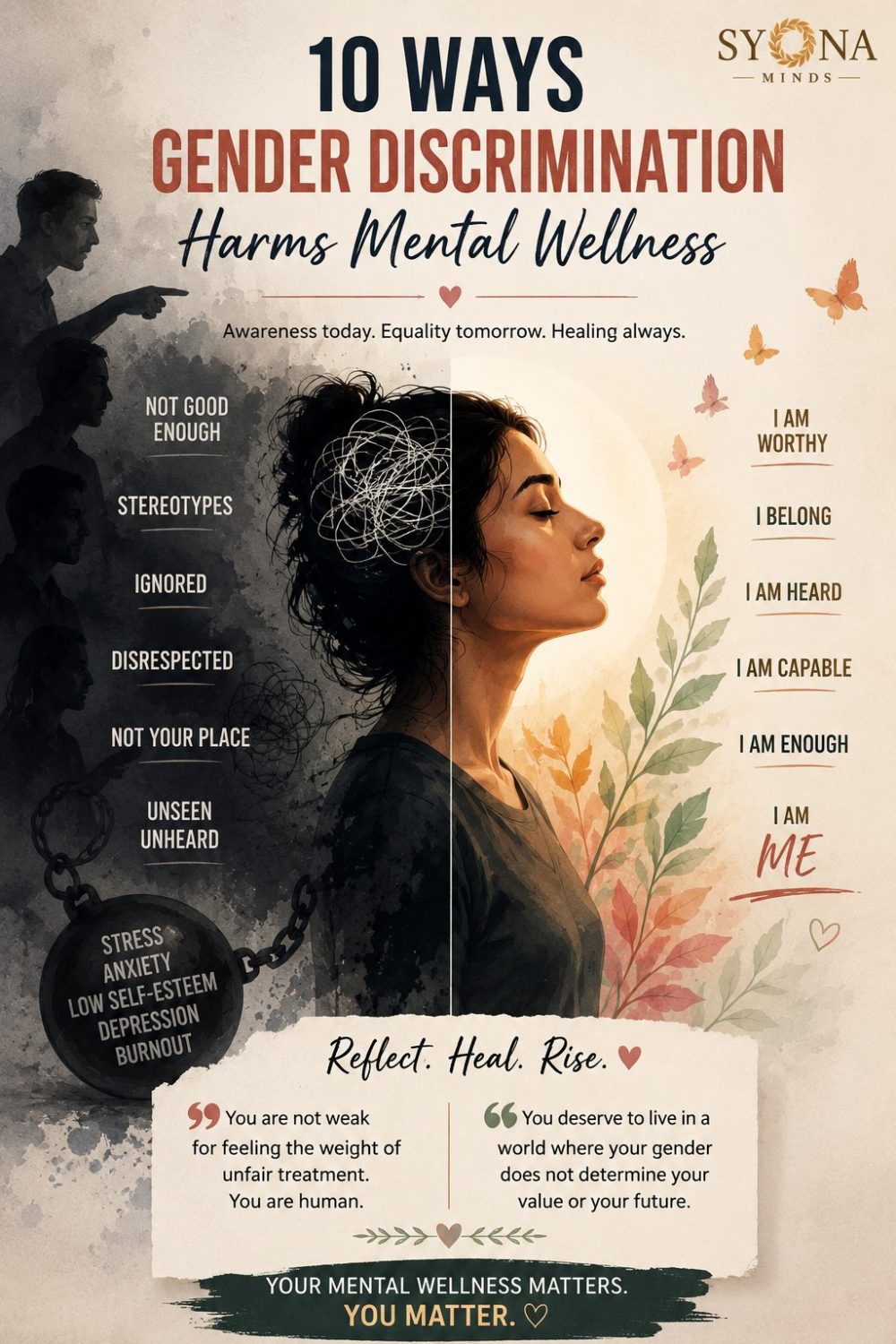
Gender discrimination is often viewed as a social or legal issue, but its effects extend far beyond unequal opportunities. From a psychological perspective, repeated experiences of unfair treatment can influence the way people think, feel, behave, and relate to others. Whether it occurs at home, in schools, workplaces, healthcare settings, or society at large, discrimination can become a chronic source of stress that affects emotional wellbeing over time.
Research suggests that individuals who frequently experience gender discrimination are at a greater risk of developing anxiety, depression, chronic stress, low self-esteem, burnout, and social withdrawal (American Psychological Association, 2022; World Health Organization, 2022). While discrimination can affect people of all genders, women and gender-diverse individuals often face unique challenges due to cultural expectations, stereotypes, and unequal access to opportunities.
Understanding the psychological impact of gender discrimination is not only important for those who experience it but also for families, educators, employers, and communities. Awareness is the first step toward building environments where mental wellbeing can thrive.
Introduction
Imagine walking into a meeting where your ideas are ignored until someone else repeats them. Imagine being told that certain careers are “not meant” for your gender, or feeling judged simply because you don’t fit society’s expectations.
For many people, these experiences are not isolated incidents they are repeated realities.
Although these moments may appear small, psychology tells us that repeated experiences of exclusion, stereotyping, or unequal treatment gradually shape the way people view themselves and the world around them.
Our brains are designed to notice threats. When unfair treatment becomes a recurring part of life, the mind begins anticipating rejection, criticism, or unequal treatment even before it happens. This constant state of alertness can become emotionally exhausting and may contribute to long-term mental health difficulties (Ehlers & Clark, 2000).
Gender discrimination is therefore not simply about inequality it is also about emotional safety, self-worth, and psychological wellbeing.
Importantly, gender discrimination can affect anyone. Men may experience pressure to suppress emotions or conform to rigid expectations of masculinity. Women often encounter barriers related to opportunity, leadership, safety, or caregiving roles. Transgender and gender-diverse individuals frequently face additional challenges, including stigma, exclusion, and reduced access to affirming healthcare (WHO, 2022).
While every individual’s experience is different, understanding these psychological effects helps us move beyond stereotypes and towards empathy, awareness, and healthier communities.
What Is Gender Discrimination?
Gender discrimination refers to the unfair or unequal treatment of a person based on their gender or gender identity. It can be obvious, such as denying someone a job opportunity because of their gender, or subtle, such as repeatedly interrupting someone’s ideas or assuming they are less capable.
Psychologists distinguish between overt discrimination, which is direct and visible, and subtle discrimination, often called microaggressions. While each small incident may seem insignificant, their cumulative effect can create ongoing psychological stress.
Examples include:
- Unequal pay for similar work
- Being overlooked for promotions
- Gender stereotypes about emotions or abilities
- Unequal household expectations
- Bullying based on gender identity
- Limited access to education or healthcare
- Harassment in workplaces or educational settings
According to Social Identity Theory, people naturally seek belonging within social groups. When individuals feel excluded or devalued because of their gender, it can threaten their sense of identity, belonging, and self-esteem (Tajfel & Turner, 1979).
Why Does Gender Discrimination Affect Mental Health?
Our mental health is shaped not only by biology but also by the environments in which we live.
Psychologists describe discrimination as a chronic psychological stressor. Unlike a single stressful event, chronic stress occurs repeatedly over time. Each experience of unfair treatment activates the body’s stress response, releasing hormones such as cortisol and adrenaline.
While these hormones are helpful during genuine danger, remaining in a prolonged state of stress can affect emotional regulation, sleep, concentration, and overall wellbeing (McEwen, 2007).
Another important concept is cognitive appraisal the way our brain interprets experiences. If someone repeatedly encounters discrimination, they may begin expecting rejection even in neutral situations. Over time, this expectation can influence confidence, relationships, and decision-making.
Psychologists also describe Minority Stress Theory, which explains that individuals from marginalized groups often experience additional psychological burdens due to stigma, discrimination, and social exclusion (Meyer, 2003).
In other words, discrimination is not simply an unpleasant experience it becomes an ongoing emotional load that the mind carries every day.
10 Psychological Effects of Gender Discrimination
1. Chronic Stress: Living in a Constant State of Alertness
One of the earliest psychological effects of discrimination is chronic stress.
Imagine constantly wondering whether you will be judged unfairly, overlooked, or treated differently. Over time, the brain begins preparing for these situations before they even occur.
Psychologists call this hypervigilance a heightened awareness of possible threats.
Instead of feeling safe, the nervous system remains on high alert. People may notice:
- Difficulty relaxing
- Irritability
- Trouble sleeping
- Frequent headaches
- Muscle tension
- Emotional exhaustion
Although stress is a normal part of life, repeated discrimination keeps the body’s stress response activated for long periods. Research suggests that prolonged exposure to stress hormones can negatively affect both physical and mental health (McEwen, 2007).
Psychological Insight: Chronic stress is not simply “feeling busy.” It reflects the body’s ongoing attempt to protect itself from situations it perceives as threatening.
2. Lower Self-Esteem and Self-Worth
Our self-esteem develops partly through the feedback we receive from others.
When individuals repeatedly hear messages directly or indirectly that they are less capable because of their gender, these beliefs may gradually become internalized.
Instead of thinking:
“People treated me unfairly.”
They may begin believing:
“Maybe I’m not good enough.”
This process is known as internalized stigma.
Low self-esteem may appear as:
- Constant self-doubt
- Fear of making mistakes
- Difficulty accepting compliments
- Reduced confidence
- Feeling undeserving of opportunities
According to Self-Determination Theory, people thrive when they experience competence, autonomy, and belonging. Discrimination undermines all three, making it harder to develop a healthy sense of self (Ryan & Deci, 2000).
Psychological Insight: Confidence is built through repeated experiences of acceptance, encouragement, and opportunity not simply positive thinking.
3. Anxiety and Constant Worry
Discrimination often creates uncertainty.
Questions such as:
“Will I be treated fairly?”
“Will people judge me?”
“Will I be taken seriously?”
may become frequent mental habits.
The brain naturally dislikes uncertainty because uncertainty can signal potential danger.
Over time, this may contribute to symptoms such as:
- Overthinking
- Restlessness
- Panic
- Difficulty concentrating
- Racing thoughts
- Increased sensitivity to criticism
Research shows that repeated experiences of discrimination are associated with higher levels of anxiety across multiple populations (APA, 2022).
Psychological Insight: Anxiety is not simply excessive worry it is the brain’s attempt to prepare for possible future threats.
4. Depression and Feelings of Hopelessness
Persistent discrimination can gradually reduce motivation and hope.
When people repeatedly feel that their efforts are ignored or that opportunities remain unfair regardless of how hard they work, they may begin experiencing learned helplessness a psychological state in which individuals feel they have little control over outcomes (Seligman, 1975).
Symptoms may include:
- Persistent sadness
- Loss of motivation
- Low energy
- Feelings of worthlessness
- Social withdrawal
- Reduced interest in activities once enjoyed
Depression is not caused by one event alone. Instead, discrimination can become one of many ongoing stressors that increase vulnerability.
Psychological Insight: Feeling powerless for long periods can change the way people view both themselves and their future.
5. Burnout and Emotional Exhaustion
Burnout is often associated with demanding jobs, but it can also result from the emotional effort required to navigate discrimination every day.
People may feel they constantly need to:
- Prove themselves
- Work harder than others
- Hide emotions
- Monitor their behaviour
- Correct stereotypes
- Avoid conflict
Psychologists refer to this as emotional labour the effort involved in managing emotions while meeting social expectations.
Over time, emotional labour can lead to:
- Exhaustion
- Reduced motivation
- Cynicism
- Difficulty concentrating
- Emotional numbness
Research indicates that prolonged workplace discrimination contributes significantly to burnout and reduced psychological wellbeing (WHO, 2022).
Psychological Insight: Burnout is not simply being tired. It is the gradual depletion of emotional, cognitive, and physical energy.
What Happens Inside the Brain?
Psychologists and neuroscientists have found that repeated experiences of stress and discrimination can influence the way different parts of the brain communicate with one another. While the brain is remarkably adaptable, prolonged stress can make emotional regulation more challenging over time.
The Amygdala – The Brain’s Alarm System
The amygdala is responsible for detecting potential threats. When someone repeatedly experiences discrimination, this region may become more sensitive, making the person more alert to signs of rejection or unfair treatment (LeDoux, 1996).
This heightened sensitivity can contribute to anxiety, hypervigilance, and emotional reactivity.
The Prefrontal Cortex – The Thinking Brain
The prefrontal cortex helps us make decisions, regulate emotions, solve problems, and evaluate situations logically.
Chronic stress can reduce the efficiency of this region, making it harder to concentrate, regulate emotions, and make balanced decisions (McEwen, 2007).
The Hippocampus – Organising Experiences
The hippocampus helps us organize memories and place experiences into context.
Research suggests that prolonged stress may affect how memories are processed and recalled, making emotionally difficult experiences more memorable and harder to move beyond (McEwen, 2007).
The Role of Cortisol
Whenever we experience stress, the body releases cortisol.
In small amounts, cortisol is helpful it prepares us to respond to challenges.
However, when discrimination becomes a frequent experience, cortisol levels may remain elevated for long periods. Persistently high cortisol has been linked to sleep difficulties, emotional exhaustion, impaired concentration, and reduced resilience (McEwen, 2007).
The Encouraging News: The Brain Can Adapt
Perhaps the most hopeful finding from psychology and neuroscience is that the brain remains capable of change throughout life.
Supportive relationships, inclusive environments, therapy, mindfulness practices, physical activity, and self-compassion have all been shown to strengthen emotional resilience and improve mental wellbeing (Davidson & McEwen, 2012).
This ability to adapt is known as neuroplasticity the brain’s remarkable capacity to reorganize itself through new experiences and healthier patterns.
Psychological Insight: Experiences of discrimination can leave emotional marks, but they do not define a person’s future. With support, understanding, and positive experiences, the brain can continue to heal and grow.
6. Identity Conflict and Difficulty Being Your Authentic Self
One of the most painful psychological effects of gender discrimination is the feeling that you cannot be yourself.
From childhood, many people receive messages about how they “should” behave based on their gender.
Examples include:
- “Boys don’t cry.”
- “Girls should be quiet.”
- “That’s not masculine.”
- “That’s not ladylike.”
Although these statements may appear harmless, they gradually shape how people view themselves.
When individuals constantly feel pressured to hide their emotions, interests, appearance, or personality to fit society’s expectations, they may begin experiencing an identity conflict.
Psychologists define identity as our understanding of who we are our values, personality, interests, beliefs, and sense of belonging. When social expectations conflict with a person’s authentic identity, emotional distress often follows.
Identity conflict may lead to:
- Feeling disconnected from yourself
- Difficulty making decisions
- Shame or guilt
- Constant self-monitoring
- Fear of expressing opinions
- Feeling “not good enough”
For transgender and gender-diverse individuals, this conflict can become even more significant when their identity is repeatedly invalidated or rejected by others (Meyer, 2003).
Psychological Insight
Healthy identity develops when people feel accepted for who they are not for who others expect them to become.
7. Social Isolation and Loneliness
Human beings are naturally social.
According to psychologists, our need to belong is one of our most fundamental psychological needs (Baumeister & Leary, 1995).
Unfortunately, discrimination often damages this sense of belonging.
People who repeatedly experience judgment may begin withdrawing from:
- Friends
- Family gatherings
- Workplaces
- Schools
- Community activities
Not because they dislike people but because isolation can sometimes feel safer than rejection.
Over time this creates a difficult cycle.
Discrimination → Withdrawal → Loneliness → Poorer Mental Health
Research consistently shows that chronic loneliness is associated with higher risks of anxiety, depression, sleep difficulties, and reduced life satisfaction (Holt-Lunstad et al., 2015).
Psychologists also explain that social support acts as a protective factor. Feeling accepted by even one supportive person can significantly reduce the emotional impact of discrimination.
Psychological Insight
Loneliness is not simply being alone it is the feeling of being unseen, unheard, or misunderstood.
8. Unhealthy Coping Behaviours
When emotional pain continues for long periods, people naturally search for ways to reduce it.
Some coping strategies are healthy.
Others provide only temporary relief while creating new problems.
Examples of unhealthy coping include:
- Excessive alcohol consumption
- Smoking or vaping
- Emotional eating
- Drug misuse
- Compulsive shopping
- Excessive gaming
- Doom-scrolling on social media
- Emotional withdrawal
These behaviours often reduce distress for a short time because they temporarily activate the brain’s reward system.
However, they rarely solve the underlying problem.
Instead, they may increase guilt, dependence, anxiety, or depression.
Psychologists emphasize that unhealthy coping is often an attempt to regulate overwhelming emotions not a sign of weakness.
Replacing unhealthy coping with healthier emotional regulation strategies is an important part of psychological recovery.
Psychological Insight
Every behaviour serves a purpose. The goal is not simply to stop unhealthy coping but to replace it with healthier ways of meeting the same emotional need.
9. Barriers to Healthcare and Psychological Support
Many people assume healthcare is equal for everyone.
Unfortunately, research suggests that gender bias can influence both physical and mental healthcare.
Some individuals report having their symptoms dismissed as:
- “You’re just emotional.”
- “It’s probably stress.”
- “You’ll get over it.”
Others delay seeking help because they fear not being taken seriously.
For transgender and gender-diverse individuals, barriers may include:
- Lack of knowledgeable professionals
- Fear of discrimination
- Difficulty accessing affirming care
Psychologically, these experiences reduce trust.
When people feel unheard, they become less likely to seek support in the future even when they genuinely need it.
This delay may allow anxiety, depression, or trauma-related symptoms to worsen over time.
Psychological Insight
Feeling listened to is one of the strongest predictors of positive therapeutic outcomes.
10. Long-Term Emotional Trauma
Not everyone who experiences discrimination develops trauma.
However, when discrimination is severe, repeated, or prolonged, it can leave lasting emotional scars.
Psychologists distinguish between:
Stress
A normal response to difficult situations.
Chronic Stress
Stress that continues over long periods without sufficient recovery.
Trauma
An emotional response to experiences that overwhelm a person’s ability to cope.
Repeated discrimination may contribute to trauma when individuals experience:
- Constant humiliation
- Harassment
- Threats
- Violence
- Ongoing exclusion
Trauma can influence:
- Trust
- Relationships
- Self-worth
- Emotional regulation
- Sense of safety
Some people may experience symptoms similar to Post-Traumatic Stress Disorder (PTSD), such as hypervigilance, intrusive memories, emotional numbness, or avoidance. However, a formal PTSD diagnosis requires meeting specific clinical criteria and should only be made by a qualified mental health professional (APA, 2022).
Psychological Insight
Trauma is not defined solely by what happened it is also shaped by how overwhelming the experience was and whether adequate support was available.
Psychological Theories That Help Explain Gender Discrimination
Psychologists have developed several theories to explain why discrimination has such a powerful effect on mental wellbeing.
1. Minority Stress Theory
Developed by psychologist Ilan Meyer, this theory explains that individuals belonging to marginalized groups experience additional stress because of prejudice, discrimination, and stigma (Meyer, 2003).
Instead of dealing only with everyday life challenges, they must also manage:
- Fear of rejection
- Social exclusion
- Internalized stigma
- Anticipation of discrimination
Over time, this additional psychological burden increases vulnerability to anxiety, depression, and emotional exhaustion.
2. Social Identity Theory
People naturally derive part of their identity from the groups to which they belong (Tajfel & Turner, 1979).
When society devalues a person’s gender identity, it can threaten:
- Self-esteem
- Confidence
- Sense of belonging
Feeling accepted within one’s community acts as an important protective factor for mental wellbeing.
3. Learned Helplessness
Martin Seligman proposed that repeated experiences of having little control over difficult situations may lead individuals to stop trying, even when opportunities later become available (Seligman, 1975).
Someone repeatedly experiencing discrimination may begin believing:
“It doesn’t matter what I do.”
This mindset contributes to depression, reduced motivation, and hopelessness.
4. Cognitive Appraisal Theory
Psychologist Richard Lazarus explained that stress depends not only on what happens but also on how we interpret it (Lazarus & Folkman, 1984).
If discrimination is viewed as unavoidable or impossible to overcome, emotional distress often increases.
Learning healthier ways of interpreting and responding to experiences can improve resilience.
5. Self-Determination Theory
According to Ryan and Deci (2000), psychological wellbeing depends on three basic needs:
- Autonomy
- Competence
- Relatedness
Discrimination undermines all three.
People flourish when they feel capable, respected, and connected.
How Can We Protect Our Mental Wellbeing?
Although discrimination is a societal issue, individuals can still develop psychological tools that promote resilience.
Build Supportive Relationships
Supportive friends, family members, mentors, or community groups help buffer the emotional effects of discrimination.
Research consistently shows that social support is one of the strongest protective factors for mental health.
Practice Self-Compassion
Instead of asking,
“What’s wrong with me?”
try asking,
“What happened to me?”
Self-compassion reduces self-criticism and encourages emotional healing (Neff, 2003).
Challenge Internalized Beliefs
Notice thoughts such as:
- “I’m not capable.”
- “I’ll never succeed.”
- “I’m the problem.”
Ask yourself:
“Whose voice is this?”
Many negative beliefs originate from repeated societal messages rather than objective reality.
Prioritize Physical Wellbeing
Exercise, quality sleep, balanced nutrition, and relaxation techniques help regulate stress hormones and improve emotional resilience.
The brain and body work together.
Supporting one supports the other.
Seek Professional Support
Therapy provides a safe environment to process difficult experiences, rebuild confidence, develop healthier coping strategies, and strengthen emotional wellbeing.
Seeking help is not a sign of weakness.
It is an investment in psychological health.
What Families, Schools, and Workplaces Can Do
Creating mentally healthy environments requires collective effort.
Families can:
- Encourage emotional expression regardless of gender.
- Challenge harmful stereotypes.
- Teach respect and empathy.
Schools can:
- Promote inclusive education.
- Address bullying promptly.
- Create safe spaces for discussion.
Workplaces can:
- Ensure equal opportunities.
- Implement anti-discrimination policies.
- Support employee mental wellbeing.
- Encourage psychologically safe leadership.
Communities thrive when everyone feels respected, valued, and included.
Key Takeaways
1. Gender discrimination affects both emotional wellbeing and long-term mental health.
2. Chronic discrimination increases stress, anxiety, depression, burnout, and social isolation.
3. Discrimination can influence brain functioning through prolonged activation of the stress response.
4. Psychological theories such as Minority Stress Theory and Self-Determination Theory help explain why these effects occur.
5. Supportive relationships, therapy, self-compassion, and inclusive environments can reduce the psychological impact.
6. Mental well-being improves not only through individual resilience but also through creating fairer and more inclusive communities.
Conclusion
Gender discrimination is often discussed in terms of equality, opportunity, and human rights. Yet psychology reminds us that its impact reaches much deeper. Repeated experiences of bias, exclusion, or stereotyping shape how people see themselves, relate to others, and navigate everyday life.
The encouraging news is that people are remarkably resilient. The brain has the capacity to adapt, heal, and grow through supportive relationships, positive experiences, effective coping strategies, and professional care. At the same time, lasting change cannot rely solely on individual resilience. Families, schools, workplaces, healthcare systems, and communities all play a role in creating environments where people feel respected, safe, and valued.
Ultimately, protecting mental health is not only about treating distress, but it is also about reducing the conditions that contribute to it. By challenging gender discrimination in all its forms, we move closer to a society where everyone has the opportunity to thrive emotionally, psychologically, and socially.
References
1. American Psychiatric Association. (2022). Diagnostic and Statistical Manual of Mental Disorders (5th ed., text rev.).
2. American Psychological Association. (2022). Stress in America™ Survey.
3. Baumeister, R. F., & Leary, M. R. (1995). The need to belong: Desire for interpersonal attachments as a fundamental human motivation. Psychological Bulletin, 117(3), 497–529.
4. Davidson, R. J., & McEwen, B. S. (2012). Social influences on neuroplasticity. Nature Neuroscience, 15(5), 689–695.
5. Ehlers, A., & Clark, D. M. (2000). A cognitive model of PTSD. Behaviour Research and Therapy, 38(4), 319–345.
6. Holt-Lunstad, J., Smith, T. B., Baker, M., Harris, T., & Stephenson, D. (2015). Loneliness and social isolation as risk factors for mortality. Perspectives on Psychological Science, 10(2), 227–237.
7. Lazarus, R. S., & Folkman, S. (1984). Stress, Appraisal, and Coping. Springer.
8. LeDoux, J. E. (1996). The Emotional Brain. Simon & Schuster.
9. McEwen, B. S. (2007). Physiology and neurobiology of stress and adaptation. Physiological Reviews, 87(3), 873–904.
10. Meyer, I. H. (2003). Prejudice, social stress, and mental health in lesbian, gay, and bisexual populations. Psychological Bulletin, 129(5), 674–697.
11. Neff, K. D. (2003). Self-compassion: An alternative conceptualization of a healthy attitude toward oneself. Self and Identity, 2(2), 85–101.
12. Ryan, R. M., & Deci, E. L. (2000). Self-Determination Theory and the facilitation of intrinsic motivation, social development, and well-being. American Psychologist, 55(1), 68–78.
13. Seligman, M. E. P. (1975). Helplessness: On Depression, Development, and Death. W. H. Freeman.
14. Tajfel, H., & Turner, J. C. (1979). An integrative theory of intergroup conflict. In The Social Psychology of Intergroup Relations.
15. World Health Organisation. (2022). World Mental Health Report: Transforming Mental Health for All.