Summary
Academic success is often celebrated as the key to a bright future, but research consistently shows that emotional intelligence (EQ) plays an equally important role in helping children lead happy, resilient, and successful lives. Emotional intelligence is the ability to recognize, understand, express, and manage emotions while also empathizing with the feelings of others. Children with strong emotional intelligence are generally better equipped to build healthy relationships, solve problems calmly, manage stress, and adapt to life’s challenges.
Unlike IQ, emotional intelligence isn’t something children are simply born with it develops over time through everyday experiences, supportive relationships, and intentional guidance from parents and caregivers. The way adults respond to children’s emotions, resolve conflicts, communicate feelings, and model empathy significantly influences how children learn to manage their own emotions.
In today’s fast-paced world, where children face academic pressure, social media influence, and increasing mental health challenges, nurturing emotional intelligence has become more important than ever. The good news is that it doesn’t require complicated techniques. Simple daily interactions listening without judgment, validating emotions, encouraging empathy, and teaching healthy coping strategies can have a lifelong impact.
This article explores what emotional intelligence is, why it matters for child development, and ten practical, evidence-based ways parents can help children grow into emotionally aware, confident, and compassionate individuals.
Introduction
Imagine two children facing the same difficult situation. Both receive disappointing exam results.
One child becomes overwhelmed, believes they’re a failure, refuses to try again, and withdraws from others.
The second child feels disappointed too but takes a deep breath, talks about their feelings, learns from their mistakes, and tries again with renewed determination.
The difference isn’t intelligence.
It’s emotional intelligence.
For decades, success was largely associated with academic ability and IQ. While cognitive skills remain important, psychologists now recognize that emotional intelligence often determines how well people manage stress, communicate, solve conflicts, build relationships, and recover from setbacks.
Children begin developing emotional intelligence from infancy. Every interaction, whether comforting a crying toddler, helping a child name their emotions, or modelling patience during stressful moments, teaches valuable lessons about understanding and managing feelings.
Parents often spend considerable time teaching children to read, write, and solve mathematical problems. Yet one of the greatest life skills they can teach is how to understand emotions.
Because children who understand their feelings are better able to understand the world around them.
What Is Emotional Intelligence?
Emotional intelligence (EI), sometimes called emotional quotient (EQ), refers to a person’s ability to recognize, understand, manage, and express emotions effectively while also understanding and responding appropriately to the emotions of others.
The concept was first introduced by psychologists Peter Salovey and John D. Mayer and later popularized by psychologist Daniel Goleman, whose research highlighted the importance of emotional intelligence in leadership, relationships, education, and personal wellbeing.
Rather than suppressing emotions, emotionally intelligent individuals learn to respond thoughtfully instead of reacting impulsively.
For children, emotional intelligence means learning to:
- Recognize different emotions.
- Understand why they feel a certain way.
- Express feelings appropriately.
- Calm themselves during stressful situations.
- Show empathy toward others.
- Solve conflicts respectfully.
- Build healthy friendships.
These skills develop gradually through everyday experiences and supportive guidance from trusted adults.
Why Emotional Intelligence Matters More Than Ever
Children today face challenges that previous generations rarely encountered.
Many experience:
- Academic competition.
- Social media comparisons.
- Cyberbullying.
- Increased screen time.
- Peer pressure.
- Anxiety about the future.
- Information overload.
Strong emotional intelligence helps children navigate these challenges with confidence and resilience.
Research suggests that emotionally intelligent children are more likely to:
- Perform better academically.
- Build positive friendships.
- Resolve conflicts peacefully.
- Demonstrate empathy.
- Cope effectively with disappointment.
- Show greater self-confidence.
- Develop stronger mental health.
- Become resilient adults.
In other words, emotional intelligence doesn’t replace academic intelligence it strengthens a child’s ability to use it effectively.
The Five Components of Emotional Intelligence
Daniel Goleman describes emotional intelligence as consisting of five interconnected skills.
Understanding these components helps parents intentionally nurture each area.
1. Self-Awareness
Self-awareness is the ability to recognise and understand one’s emotions. Children with self-awareness can identify feelings such as happiness, frustration, disappointment, excitement, embarrassment, or fear.
Instead of simply saying:
“I feel bad.”
They gradually learn to express:
“I’m nervous because it’s my first day at school.”
Self-awareness forms the foundation for every other emotional skill.
2. Self-Regulation
Recognizing emotions is only the first step.
Children also need to learn healthy ways of managing them.
Self-regulation involves:
- Calming down after becoming upset.
- Thinking before reacting.
- Managing frustration.
- Delaying gratification.
- Choosing constructive responses.
These abilities develop gradually through practice and adult guidance.
3. Motivation
- Emotionally intelligent children learn to stay focused on meaningful goals even when challenges arise.
- Rather than giving up after one setback, they understand that effort, persistence, and learning from mistakes contribute to success.
- Parents can strengthen intrinsic motivation by praising effort instead of perfection.
4. Empathy
Empathy is the ability to understand and appreciate another person’s feelings and perspective.
Empathetic children often:
- Comfort friends who are upset.
- Recognize when someone feels excluded.
- Show kindness.
- Consider how their actions affect others.
Empathy plays an essential role in developing healthy relationships.
5. Social Skills
Emotional intelligence also includes the ability to communicate effectively, cooperate with others, resolve disagreements respectfully, and build positive relationships.
Strong social skills help children navigate friendships, teamwork, and future professional environments.
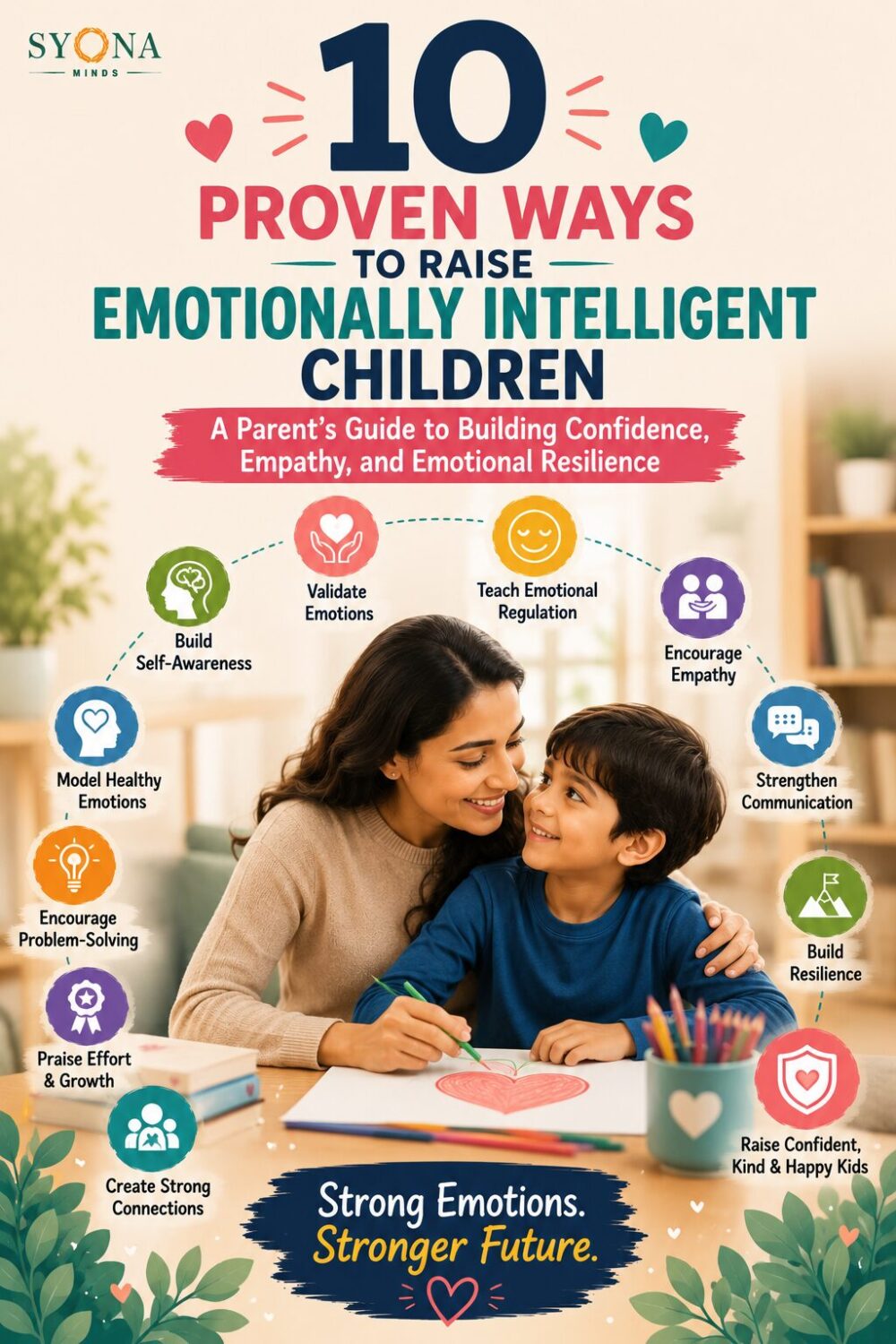
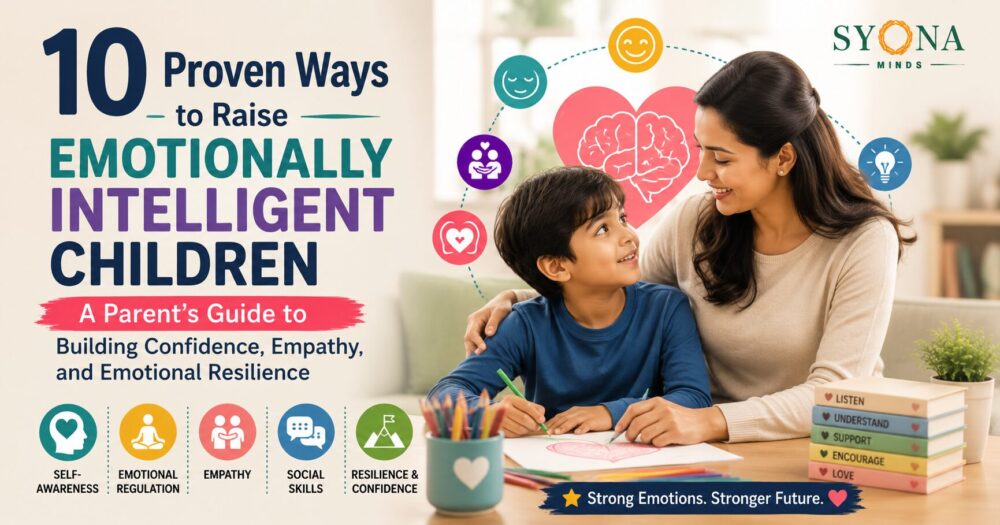
10 Proven Ways to Raise Emotionally Intelligent Children
1. Model Healthy Emotional Behavior
Children learn more from what parents do than from what they say. If parents express emotions respectfully, apologize after mistakes, remain calm during stressful situations, and communicate openly, children naturally begin adopting those behaviors.
Instead of hiding emotions, model healthy expression.
For example:
“I’m feeling frustrated because today has been busy. I’m going to take a few deep breaths before we continue.”
This teaches children that emotions are normal and manageable.
Why It Matters
Children imitate emotional behaviors they observe regularly. Being a positive role model is one of the most effective ways to develop emotional intelligence.
2. Encourage Children to Talk About Their Feelings
Children often struggle to explain emotions simply because they lack the vocabulary. Create an environment where emotions are welcomed rather than judged.
Instead of asking only:
“How was school?”
Try questions like:
- “What made you happy today?”
- “Did anything frustrate you?”
- “When did you feel proud today?”
- “Was there anything that worried you?”
Listen without immediately correcting, minimizing, or solving every problem. Sometimes children simply need to feel heard.
Why It Matters
Regular conversations help children recognize emotions, build trust, and improve emotional awareness.
3. Teach Emotional Vocabulary
Children cannot manage emotions they cannot identify. Expand their emotional vocabulary beyond words like “happy,” “sad,” or “angry.”
Introduce words such as:
- Disappointed
- Nervous
- Excited
- Proud
- Frustrated
- Lonely
- Embarrassed
- Hopeful
- Confused
- Grateful
Books, storytelling, and everyday conversations provide excellent opportunities to explore these emotions together.
Why It Matters
Naming emotions reduces confusion and helps children communicate their needs more effectively.
4. Validate Feelings Before Correcting Behavior
One of the biggest misconceptions in parenting is that validating emotions means approving inappropriate behavior.
These are two different things.
Instead of saying:
“Stop crying. It’s nothing.”
Try:
“I understand you’re disappointed that playtime is over. It’s okay to feel upset, but it’s time to get ready for bed.”
Children learn that all emotions are acceptable even though not every behavior is.
Why It Matters
Validation helps children feel understood while teaching appropriate emotional regulation.
5. Teach Empathy Through Everyday Experiences
Empathy grows through conversations and observation.
Use everyday situations to encourage perspective-taking.
Ask questions like:
- “How do you think your friend felt?”
- “What could you do to help?”
- “Have you ever felt that way?”
Reading books together is another excellent opportunity.
Discuss characters’ emotions and motivations rather than focusing only on the plot.
Why It Matters
Empathy strengthens friendships, reduces conflict, and encourages compassionate behavior.
6. Help Children Develop Healthy Coping Skills
Every child experiences disappointment, frustration, fear, and sadness. The goal isn’t to protect children from difficult emotions but to teach them healthy ways to respond.
Introduce simple coping strategies that children can use when emotions feel overwhelming:
- Take slow, deep breaths.
- Count to ten before reacting.
- Draw or write about their feelings.
- Listen to calming music.
- Take a short walk outside.
- Hug a trusted adult.
- Spend a few quiet minutes reading or relaxing.
You can even create a “Calm Corner” at home with books, coloring materials, soft cushions, or sensory toys where children can regulate their emotions in a safe space.
Why It Matters
Children who develop healthy coping mechanisms are less likely to react impulsively and more likely to handle challenges with resilience and confidence.
7. Encourage Problem-Solving Instead of Solving Every Problem
As parents, it’s natural to want to fix every challenge our children face. However, constantly stepping in can prevent them from developing confidence in their own abilities.
Instead of immediately offering solutions, ask guiding questions such as:
- “What do you think you could do?”
- “What are your options?”
- “How do you think that choice might work?”
- “Would you like to brainstorm together?”
This approach teaches children to think critically, evaluate consequences, and develop independence while knowing they have your support.
Why It Matters
Problem-solving builds confidence, emotional resilience, decision-making skills, and perseverance—qualities that contribute to success throughout life.
8. Praise Effort, Kindness, and Emotional Growth
Many children grow up believing they are valued only for achievements such as grades, sports, or awards.
While accomplishments deserve recognition, it’s equally important to celebrate qualities like:
- Kindness.
- Honesty.
- Persistence.
- Courage.
- Responsibility.
- Patience.
- Empathy.
- Cooperation.
Instead of saying:
“You’re so smart.”
Try:
“I’m proud of how patiently you kept trying.”
Or:
“That was thoughtful of you to help your friend.”
This reinforces the idea that character and effort matter just as much as outcomes.
Why It Matters
Children who receive process-focused praise tend to develop greater intrinsic motivation, self-esteem, and emotional resilience.
9. Create Opportunities for Social Connection
Emotional intelligence develops through relationships.
Encourage your child to participate in activities where they can practice communication, cooperation, and empathy, such as:
- Team sports.
- Drama or music groups.
- Scouts or youth organizations.
- Community volunteering.
- Group art classes.
- School clubs.
Family interactions are equally important. Eating meals together, playing board games, or simply talking about the day’s experiences strengthens emotional bonds and communication skills.
Why It Matters
Positive social experiences help children develop confidence, cooperation, conflict-resolution skills, and empathy toward others.
10. Build Emotional Intelligence Through Everyday Moments
Teaching emotional intelligence doesn’t require formal lessons.
Everyday life provides countless opportunities.
For example:
When watching a movie, ask:
- “How do you think that character feels?”
During sibling disagreements:
- “What happened from your brother’s perspective?”
After a difficult day:
- “What helped you feel better today?”
When reading books:
- Discuss characters’ emotions and decisions.
These conversations help children connect emotions with actions and understand different perspectives naturally.
Why It Matters
Consistent, everyday practice helps emotional intelligence become a lifelong habit rather than an occasional lesson.
Common Parenting Mistakes That Can Affect Emotional Intelligence
Even loving parents sometimes unintentionally discourage emotional growth.
Being aware of these habits can help create a more emotionally supportive environment.
Ignoring or Dismissing Feelings
Statements such as:
- “You’re fine.”
- “Stop crying.”
- “Don’t be so sensitive.”
may unintentionally teach children that emotions should be hidden instead of understood.
Instead, acknowledge their feelings before offering reassurance or guidance.
Expecting Children to Always Be Happy
- Children experience the full range of human emotions.
- Allowing sadness, disappointment, fear, or frustration creates opportunities to develop emotional resilience.
- Negative emotions are not failures they’re valuable learning experiences.
Overreacting to Mistakes
- When children fear punishment for every mistake, they may hide emotions or avoid taking healthy risks.
- Instead, treat mistakes as opportunities for learning and growth.
Not Modeling Emotional Regulation
- Children observe how adults respond to stress.
- If parents frequently yell, blame others, or suppress emotions, children may imitate those patterns.
- Model calm communication, self-awareness, and healthy coping strategies whenever possible.
How Parents and Schools Can Work Together
Children thrive when the important adults in their lives work together.
Parents can strengthen emotional learning by:
- Communicating regularly with teachers.
- Supporting school social-emotional learning (SEL) programs.
- Reinforcing emotional vocabulary at home.
- Encouraging respectful communication.
- Helping children navigate peer conflicts constructively.
Teachers and parents share the same goal: helping children become emotionally healthy, confident learners.
Consistency across home and school provides children with clear expectations and supportive guidance.
The Long-Term Benefits of Emotional Intelligence
Children who develop strong emotional intelligence often carry these skills into adolescence and adulthood.
Research suggests emotionally intelligent individuals are more likely to:
- Build healthy friendships.
- Form stable relationships.
- Communicate effectively.
- Resolve conflicts peacefully.
- Manage stress more effectively.
- Demonstrate leadership qualities.
- Show empathy and compassion.
- Maintain better mental health.
- Perform well academically and professionally.
- Adapt successfully to life’s changes.
These benefits extend far beyond childhood and contribute to overall wellbeing throughout life.
Key Takeaways
✔ Emotional intelligence helps children understand, express, and manage emotions effectively.
✔ Parents play the most influential role in developing emotional intelligence through everyday interactions.
✔ Listening, validating emotions, and modeling healthy emotional behavior strengthen emotional development.
✔ Empathy, communication, and problem-solving are skills that can be taught and practiced.
✔ Emotional intelligence supports stronger relationships, better mental health, academic success, and lifelong resilience.
✔ Small, consistent parenting habits often have the greatest long-term impact.
Frequently Asked Questions (FAQs)
What is emotional intelligence in children?
Emotional intelligence is a child’s ability to recognize, understand, express, and regulate emotions while also empathizing with the feelings of others. It supports healthy relationships, resilience, and overall wellbeing.
At what age does emotional intelligence begin to develop?
Emotional intelligence begins developing in infancy through secure relationships with caregivers. As children grow, parents, teachers, and everyday experiences continue shaping emotional awareness and regulation.
Can emotional intelligence be taught?
Yes. Emotional intelligence develops through consistent guidance, positive role modeling, open communication, empathy, and opportunities to practice healthy emotional skills.
Why is emotional intelligence important for school success?
Children with strong emotional intelligence often manage stress better, cooperate with classmates, communicate effectively, solve problems constructively, and remain motivated during challenges.
How can parents improve their child’s emotional intelligence every day?
Simple habits such as talking about emotions, validating feelings, reading together, modeling empathy, encouraging problem-solving, and spending quality time together help strengthen emotional intelligence over time.
Conclusion
Raising an emotionally intelligent child is one of the greatest gifts a parent can offer. While academic achievement and extracurricular success are valuable, the ability to understand emotions, show empathy, communicate effectively, and recover from setbacks often determines how children navigate life’s challenges. Emotional intelligence equips them with the confidence to build meaningful relationships, make thoughtful decisions, and approach both success and failure with resilience.
The encouraging news is that emotional intelligence is not a fixed trait it grows through everyday experiences. Every time parents listen with patience, validate a child’s feelings, model respectful communication, or guide them through difficult emotions, they strengthen skills that will benefit the child for years to come. These small, consistent moments of connection often have a greater impact than occasional grand gestures.
Children also learn by observing. When parents manage their own emotions with self-awareness, apologize after mistakes, and demonstrate kindness and empathy in daily life, they provide a powerful example of emotional intelligence in action. Over time, these behaviors become part of the child’s own emotional toolkit.
At Syona Minds, we believe that nurturing emotional intelligence is just as important as supporting academic growth. By helping children understand themselves and connect compassionately with others, parents lay the foundation for lifelong confidence, resilience, healthy relationships, and overall mental wellbeing. Every conversation, every comforting hug, and every moment of empathy contributes to raising emotionally strong individuals who are prepared to thrive in an ever-changing world.
References
1. Brackett, M. A. (2019). Permission to Feel: Unlocking the Power of Emotions to Help Our Kids, Ourselves, and Our Society Thrive. Celadon Books.
2. Collaborative for Academic, Social, and Emotional Learning (CASEL). (2023). What Is Social and Emotional Learning?
3. Goleman, D. (2006). Emotional Intelligence: Why It Can Matter More Than IQ (10th Anniversary ed.). Bantam Books.
4. Salovey, P., & Mayer, J. D. (1990). Emotional Intelligence. Imagination, Cognition and Personality, 9(3), 185–211.
5. World Health Organization. (2023). Mental Health of Children and Adolescents.