Summary
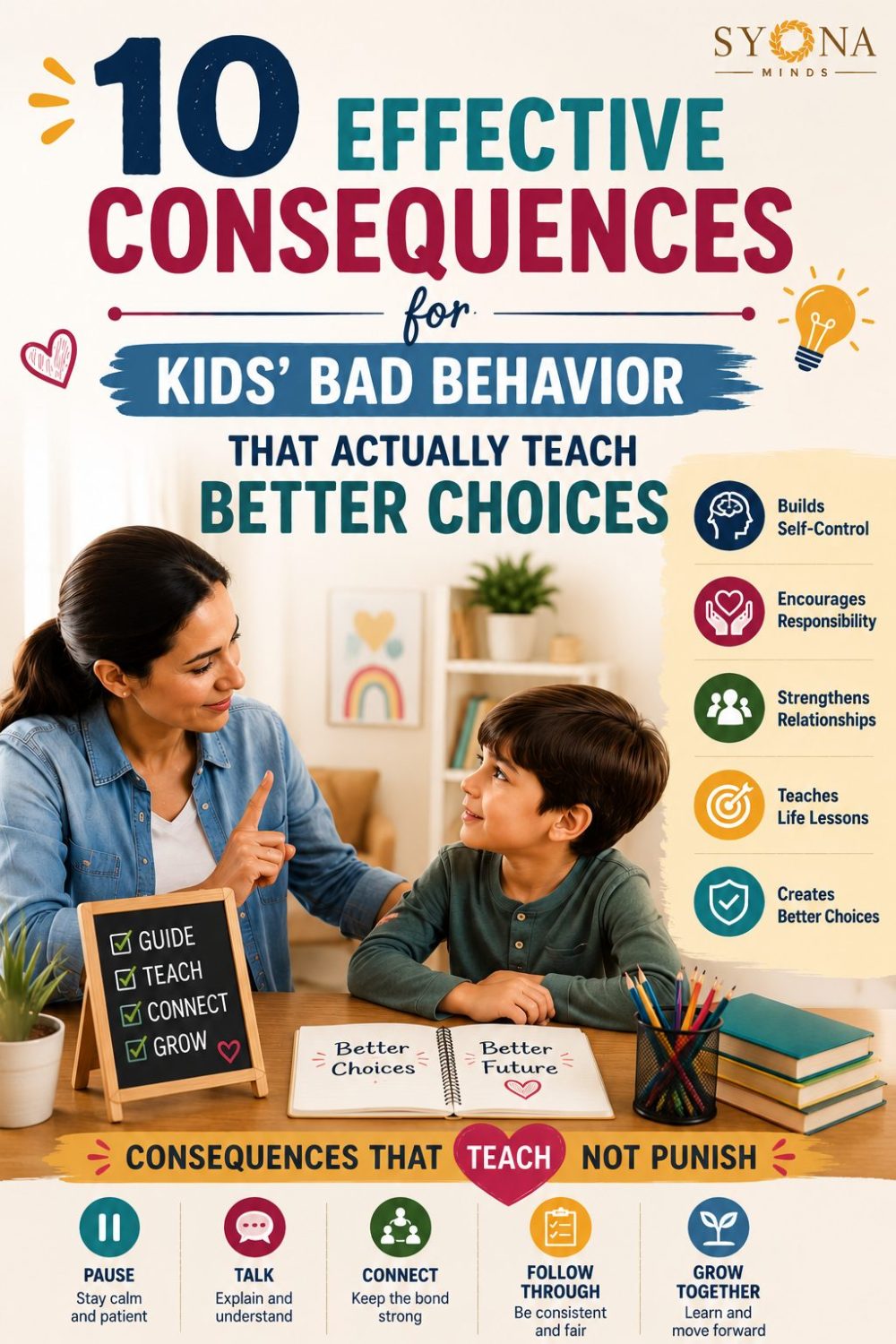
Every child tests boundaries from time to time. Tantrums, refusing to follow instructions, arguing with siblings, lying, or ignoring household rules are all common behaviors as children learn how to manage emotions and navigate the world around them. While these moments can be frustrating, they also provide valuable opportunities for teaching responsibility, empathy, and self-control.
Many parents instinctively respond to misbehavior with punishment. However, research in child psychology suggests that punishment alone rarely teaches children why their behavior was inappropriate or how to make better choices in the future. Instead, effective consequences focus on helping children understand the connection between their actions and the outcomes that follow.
When consequences are calm, consistent, age-appropriate, and respectful, they become powerful learning experiences rather than moments of fear or shame. They encourage accountability, problem-solving, and emotional regulation while preserving the parent-child relationship.
In this article, we’ll explore ten evidence-based consequences that help children learn from their mistakes without relying on harsh punishment. You’ll also discover practical parenting strategies that encourage positive behavior while supporting your child’s emotional and social development.
Introduction
No parent enjoys correcting their child’s behavior. Whether your child refuses to clean up their toys, talks back, ignores instructions, or gets into arguments with siblings, it’s natural to wonder:
“What’s the best way to respond?”
For generations, many families believed that strict punishment was the most effective way to discipline children. However, modern research tells a different story. Children learn best when discipline teaches rather than simply punishes.
Instead of asking:
“How do I stop this behavior?”
Positive parenting encourages parents to ask:
“What is my child learning from my response?”
Every challenging behavior presents an opportunity to teach important life skills like responsibility, empathy, emotional regulation, and problem-solving. Effective consequences don’t embarrass, shame, or frighten children. Instead, they help children understand that every choice has an outcome and that they have the power to make better choices in the future.
Let’s first understand the difference between punishment and consequences.
Punishment vs. Consequences: What’s the Difference?
Although these terms are often used interchangeably, they are not the same.
Punishment
Punishment focuses primarily on making a child suffer for unwanted behavior.
Examples include:
- Yelling
- Harsh criticism
- Physical discipline
- Public embarrassment
- Taking away unrelated privileges
Punishment may stop behavior temporarily, but it often creates fear rather than understanding. Children may become more focused on avoiding punishment than learning why their behavior was inappropriate.
Consequences
- Consequences are designed to teach responsibility.
- They help children understand the natural results of their actions while encouraging better decision-making.
- For example:
If a child throws toys repeatedly after being reminded to stop, the toys are put away for the rest of the day.
The consequence is directly related to the behavior. This teaches accountability rather than fear.
Why Consequences Help Children Learn
Children are still developing important brain functions responsible for:
- Self-control
- Emotional regulation
- Planning
- Decision-making
- Understanding long-term consequences
Because these skills are still growing, children often need guidance not simply punishment.
Effective consequences help children:
- Recognize mistakes.
- Understand cause and effect.
- Develop responsibility.
- Practice self-control.
- Learn problem-solving skills.
- Build empathy.
When consequences are delivered calmly, children are more likely to reflect on their behavior instead of becoming defensive.
Principles of Effective Consequences
Before choosing a consequence, keep these important principles in mind.
1. Stay Calm
- Children learn more from calm guidance than emotional reactions.
- If parents respond with yelling or anger, children often focus on the parent’s emotions instead of their own behavior.
- Take a deep breath before responding.
2. Be Consistent
- Consistency helps children feel secure because they understand what to expect.
- If a behavior sometimes has consequences and other times doesn’t, children receive mixed messages.
- Consistency builds trust and predictability.
3. Make Consequences Related to the Behavior
The best consequences naturally connect to the behavior.
For example:
- Drawing on walls → Help clean the wall.
- Refusing homework → Complete homework before leisure activities.
- Throwing toys → Toys are put away temporarily.
Related consequences make learning much clearer.
4. Keep Consequences Age-Appropriate
- Expectations should match a child’s developmental stage.
- A preschooler and a teenager require different approaches.
- Very young children benefit from simple, immediate consequences.
- Older children can participate in discussions and problem-solving.
5. Focus on Teaching, Not Winning
- Discipline isn’t about proving authority.
- Its purpose is helping children develop lifelong skills.
- Ask yourself:
“What do I want my child to learn from this experience?”
10 Effective Consequences for Kids’ Bad Behavior
1. Calm Time-Out for Emotional Reset
Time-out has sometimes been criticised for being misused as punishment. However, when used correctly, a brief, calm time-out can help children regulate overwhelming emotions.
Instead of saying:
“Go away because you’re bad.”
Try:
“Let’s take a few quiet minutes to help our bodies calm down. Then we’ll talk.”
Choose a quiet, safe space without distractions.
General guideline:
- One minute per year of age for younger children.
Afterward, discuss:
- What happened?
- How were you feeling?
- What could you do differently next time?
Why It Works
Time-outs help children:
- Calm their nervous system.
- Practice emotional regulation.
- Reflect before returning to play.
2. Temporary Loss of Privileges
Privileges, not necessities, can be temporarily removed when directly connected to inappropriate behaviour.
Examples include:
- Screen time
- Video games
- Favorite toys
- Social outings
- Leisure activities
For example:
If your child repeatedly ignores screen-time rules, they may lose screen privileges for the following day.
The consequence should be:
- Reasonable
- Short-term
- Clearly explained
Why It Works
Children begin understanding that responsible behavior earns enjoyable privileges.
3. Logical Consequences
Logical consequences directly relate to the child’s actions.
Examples:
- Refuses to wear a coat → Experiences feeling cold briefly (when safe).
- Leaves bicycle outside → Bicycle is stored away temporarily.
- Doesn’t complete homework → Homework is finished before playtime.
Logical consequences encourage responsibility because children experience the natural results of their own decisions.
4. Positive Behavior Reinforcement
Sometimes the most effective response to misbehavior is increasing attention toward positive behavior instead.
Rather than constantly correcting mistakes, intentionally notice moments when your child behaves well.
Instead of saying:
“Finally, you cleaned your room.”
Try:
“I noticed you put away your toys without being asked. That showed responsibility.”
Specific praise reinforces exactly what you want repeated.
Examples of Positive Reinforcement
- Verbal praise
- Stickers
- Extra storytime
- Choosing dinner
- Family game night
- Activity coupons
Why It Works
Children naturally repeat behaviors that receive positive attention.
5. Restitution: Repairing the Harm
One of the most meaningful consequences is helping children repair the impact of their actions. If they break something, they help fix or replace it.
If they hurt someone’s feelings, they apologise sincerely and consider ways to make things right.
Examples include:
- Cleaning up a mess they created.
- Helping rebuild a sibling’s block tower.
- Writing an apology note.
- Assisting with repairs.
Why It Works
Restitution teaches:
- Empathy
- Accountability
- Problem-solving
- Responsibility
Instead of simply feeling punished, children actively participate in making things better.
6. Missing Out on a Special Privilege
Children naturally value special experiences, whether it’s attending a sleepover, watching a favorite movie, or playing a weekend video game. Temporarily losing a special privilege can be an effective consequence but only when it’s directly connected to the behavior and used thoughtfully.
For example:
- If your child repeatedly refuses to complete their responsibilities before a family outing, they may miss a portion of that activity.
- If they misuse screen time despite repeated reminders, they may lose access to it for a day.
The goal isn’t to disappoint or shame your child but to help them understand that privileges are earned through responsible behavior.
Why It Works
Special privileges motivate children because they are meaningful to them. When children see a clear connection between their choices and the outcomes, they begin developing self-discipline and accountability.
Tip: Avoid cancelling major family celebrations or birthdays as punishment. Consequences should be reasonable, proportional, and short-term.
7. Extra Responsibility Instead of Extra Punishment
Instead of assigning meaningless punishments, encourage children to contribute positively by taking on an additional responsibility.
For example:
- Help organize the bookshelf after repeatedly leaving books on the floor.
- Assist with washing the family car after carelessly making a mess in the garage.
- Help prepare dinner after wasting food.
These tasks shouldn’t feel humiliating; they should reinforce responsibility and contribution.
Developmental Benefits
Extra responsibilities help children develop:
- Independence
- Responsibility
- Problem-solving
- Respect for shared spaces
- Appreciation for others’ efforts
Children often gain confidence when trusted with meaningful responsibilities.
8. Behavior Reflection and Problem-Solving
One of the most powerful consequences is helping children think about why something happened and how they can respond differently next time. Instead of immediately giving a punishment, invite your child to reflect.
Questions might include:
- What happened?
- What were you feeling?
- How do you think your actions affected others?
- What could you do differently next time?
- Is there anything you need to do to make things right?
Older children may enjoy writing their thoughts in a behavior reflection journal, while younger children can draw pictures or talk through the experience.
Why It Works
Reflection strengthens:
- Emotional awareness
- Critical thinking
- Accountability
- Self-regulation
Children gradually learn to solve problems instead of reacting impulsively.
9. Collaborative Problem-Solving
Discipline works best when children are involved in finding solutions rather than simply receiving consequences.
For example, if siblings constantly argue over toys, ask:
“What ideas do you both have to solve this problem fairly?”
If homework is becoming a daily struggle, discuss:
“What would help make homework time easier?”
Working together teaches children that challenges can often be solved through communication and cooperation.
Benefits
Collaborative problem-solving encourages:
- Communication
- Negotiation
- Responsibility
- Respect for others
- Decision-making
Children are often more motivated to follow solutions they helped create.
10. Consistent Rules and Follow-Through
Perhaps the most effective consequence isn’t a specific strategy at all it’s consistency. Children feel more secure when family expectations remain predictable.
Clearly explain:
- Family rules
- Expected behaviors
- Consequences for breaking rules
- Opportunities to repair mistakes
For example:
Instead of changing the rules every day, calmly follow through with the same consequence each time a particular behavior occurs. Consistency helps children understand that expectations are reliable rather than based on a parent’s mood.
Why It Works
Consistent parenting builds:
- Trust
- Emotional security
- Self-discipline
- Respect for boundaries
Children thrive when they know what to expect.
Common Discipline Mistakes Parents Should Avoid
Even the best consequences can lose their effectiveness if they are delivered in ways that confuse or overwhelm children.
1. Using Consequences in Anger
When emotions run high, parents may respond with harsh punishments they later regret.
Examples include:
- Yelling
- Name-calling
- Making unrealistic threats
- Giving excessively long punishments
Instead, take a few moments to calm yourself before responding. Children learn emotional regulation by watching how adults manage their own emotions.
2. Giving Consequences That Don’t Match the Behaviour
- Consequences are most effective when they are logically connected to the child’s actions.
- For example:
❌ Taking away a bicycle because homework wasn’t completed.
✅ Homework must be completed before riding the bicycle.
- Logical consequences are easier for children to understand and accept.
3. Being Inconsistent
- If one day a behavior is ignored and the next day it results in a severe punishment, children receive mixed messages.
- Consistency not severity is what helps children learn.
4. Overusing Punishment Instead of Encouragement
- Children need correction, but they also need recognition for doing well.
- Experts often recommend aiming for significantly more positive interactions than corrective ones.
- Praise effort, kindness, responsibility, and cooperation whenever possible.
5. Expecting Perfection
- Children are still learning.
- Mistakes are part of healthy development.
- Rather than expecting perfect behavior, focus on gradual improvement and celebrating progress.
Tips for Making Consequences More Effective
To help consequences become learning opportunities rather than punishments, keep these strategies in mind:
Stay Calm
Respond with a calm, steady voice instead of reacting emotionally.
Be Immediate
Young children connect actions and consequences more easily when they happen soon after the behavior.
Explain Briefly
Long lectures often overwhelm children. Keep explanations short and clear.
Offer a Fresh Start
Once the consequence is complete, avoid repeatedly bringing up the mistake. Children need opportunities to move forward and try again.
Recognize Positive Change
Notice when your child makes better choices. Simple statements like:
“I saw how patiently you waited your turn today.”
can be more powerful than expensive rewards.
Key Takeaways
✔ Consequences are most effective when they teach rather than punish.
✔ Calm, respectful discipline helps children develop responsibility and self-control.
✔ Logical consequences are easier for children to understand than unrelated punishments.
✔ Positive reinforcement should accompany consequences to encourage lasting behavior change.
✔ Consistency and emotional connection are essential for effective parenting.
✔ Every mistake is an opportunity for learning, growth, and stronger family relationships.
Frequently Asked Questions
What is the difference between punishment and consequences?
Punishment is primarily intended to make a child suffer for misbehavior, while consequences are designed to help children understand the results of their actions and encourage better choices in the future.
At what age should children experience consequences?
Even toddlers can begin learning simple, age-appropriate consequences, such as helping clean up toys they threw. As children grow, consequences should become more collaborative and encourage problem-solving.
Should parents always use time-outs?
Not necessarily. Time-outs can be effective for some children when used calmly as an opportunity to regulate emotions rather than as a punishment. Other strategies, such as logical consequences, reflection, or restitution, may be more appropriate depending on the situation.
What if consequences don’t seem to work?
If a consequence is consistently ineffective, consider whether it is:
- Related to the behavior.
- Age-appropriate.
- Applied consistently.
- Delivered calmly.
Persistent behavioral concerns may benefit from guidance from a pediatrician or child psychologist.
Can positive reinforcement reduce bad behavior?
Yes. Research consistently shows that recognizing and encouraging positive behavior is one of the most effective ways to reduce unwanted behaviors over time. Children are more likely to repeat behaviors that receive positive attention and encouragement.
Conclusion
Every child makes mistakes; it is a natural and essential part of learning. The goal of discipline is not to create fear or demand perfection but to guide children toward making thoughtful, responsible choices. When parents shift their focus from punishment to teaching, discipline becomes an opportunity for growth rather than conflict.
Effective consequences help children understand that actions have outcomes while preserving their sense of dignity and self-worth. Strategies such as logical consequences, restitution, positive reinforcement, reflection, and collaborative problem-solving teach valuable life skills that extend far beyond childhood. They help children develop empathy, accountability, emotional regulation, and resilience qualities that contribute to healthy relationships and lifelong success.
It’s also important to remember that no parenting approach works perfectly every time. Children learn through repetition, patience, and consistent guidance. Some days will be more challenging than others, and that’s okay. What matters most is creating a home environment where mistakes are viewed as opportunities to learn, not reasons for shame.
At Syona Minds, we believe that the strongest discipline is built on connection, respect, and understanding. By combining clear expectations with compassionate guidance, parents can help children grow into confident, responsible, and emotionally healthy individuals who are prepared to make positive choices throughout their lives.
References
1. American Academy of Pediatrics. (2023). Effective Discipline to Raise Healthy Children.
2. Centers for Disease Control and Prevention. (2023). Positive Parenting Tips.
3. Kazdin, A. E. (2008). The Kazdin Method for Parenting the Defiant Child. Houghton Mifflin.
4. Siegel, D. J., & Bryson, T. P. (2016). No-Drama Discipline. Bantam Books.
5. Webster-Stratton, C. (2019). The Incredible Years: A Trouble-Shooting Guide for Parents of Children Aged 2–8 Years.