Summary
Autism Spectrum Disorder (ASD) is one of the most widely discussed neurodevelopmental conditions today, yet it remains one of the most misunderstood. While awareness about autism has grown significantly over the past decade, many outdated beliefs and misconceptions continue to influence how autistic individuals are perceived and treated.
Some people still believe that autistic individuals lack emotions, cannot form meaningful relationships, or are all mathematical geniuses. Others mistakenly think autism is caused by poor parenting or vaccines—myths that have been repeatedly disproven by decades of scientific research. Unfortunately, these misconceptions can create stigma, delay diagnosis, discourage families from seeking support, and prevent autistic individuals from receiving the understanding and opportunities they deserve.
The truth is that autism is a spectrum, meaning every autistic person has unique strengths, challenges, interests, and ways of experiencing the world. No two autistic individuals are exactly alike.
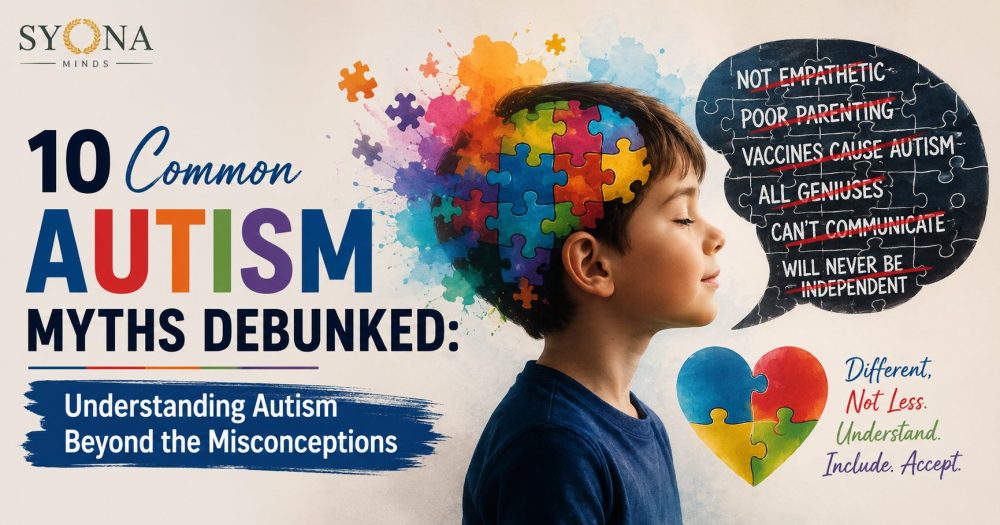
This article explores ten of the most common autism myths, explains the psychological science behind each misconception, and provides evidence-based facts to promote greater understanding, empathy, and acceptance. Whether you’re a parent, educator, caregiver, student, or simply someone who wants to learn more, understanding autism begins with separating myths from facts.
Introduction
Imagine walking into a room where the lights feel unbearably bright.
Every conversation sounds equally loud.
The smell of someone’s perfume feels overwhelming.
Someone unexpectedly touches your shoulder, and your entire body tenses.
Now imagine trying to learn, socialize, and communicate while experiencing all of this at once.
For many autistic individuals, everyday environments can feel far more intense than they do for most people.
Autism is not simply a medical diagnosis.
It represents a different way of experiencing and processing the world.
Some autistic people communicate verbally, while others use alternative methods of communication.
Some enjoy social interaction but struggle to understand social cues.
Others prefer quieter environments and limited social engagement.
Some require lifelong support, while others live independently and build successful careers.
There is no single “autistic experience.”
Yet despite growing awareness, countless myths continue to shape public opinion.
These misconceptions often create more challenges than autism itself.
Instead of receiving understanding, many autistic individuals face judgment.
Instead of receiving support, families encounter misinformation.
Replacing myths with facts is one of the most meaningful steps we can take toward building a more inclusive society.
What Is Autism Spectrum Disorder?
Autism Spectrum Disorder (ASD) is a neurodevelopmental condition that influences how a person communicates, interacts socially, processes sensory information, and experiences the world.
The word “spectrum” is important because autism presents differently in every individual.
Some autistic people:
- Need significant daily support.
- Live independently.
- Communicate verbally.
- Prefer non-verbal communication methods.
- Have exceptional memory or creative abilities.
- Experience sensory sensitivities.
- Develop intense interests in specific topics.
Autism is not a disease that needs to be cured.
Instead, many professionals and autistic advocates describe it as a natural variation in human brain development.
Support focuses on improving quality of life, communication, emotional wellbeing, education, and independence not changing who someone fundamentally is.
According to the Centers for Disease Control and Prevention (CDC), approximately 1 in 31 children in the United States has been identified with Autism Spectrum Disorder, highlighting the importance of greater awareness and acceptance.
Why Autism Myths Are Harmful
Misunderstandings about autism don’t simply create confusion.
They affect real lives.
When myths spread, they can lead to:
- Delayed diagnosis.
- Missed opportunities for early intervention.
- Social isolation.
- Bullying.
- Employment discrimination.
- Mental health challenges.
- Increased stress for families.
Children who receive appropriate understanding and support early often develop stronger communication skills, emotional regulation, independence, and confidence.
Accurate information helps families make informed decisions while encouraging communities to become more inclusive.
The Psychology Behind Autism Misconceptions
Why do so many myths about autism continue to exist?
Psychologists suggest several reasons.
People Prefer Simple Explanations
The human brain naturally searches for easy answers.
Because autism is complex, many people rely on oversimplified explanations that feel easier to understand even when they’re inaccurate.
Media Representation Has Been Limited
For many years, movies and television often portrayed autistic characters in narrow ways.
Most representations focused on exceptional intelligence or severe disability, overlooking the enormous diversity within the autism spectrum.
This created unrealistic expectations about what autism “looks like.”
Confirmation Bias
People often notice information that supports what they already believe while ignoring evidence that challenges those beliefs.
This psychological tendency helps myths persist long after scientific research has disproven them.
Lack of Personal Experience
Many misconceptions simply arise because people have never knowingly interacted with an autistic person.
Education and meaningful interaction are among the most effective ways to reduce stigma.
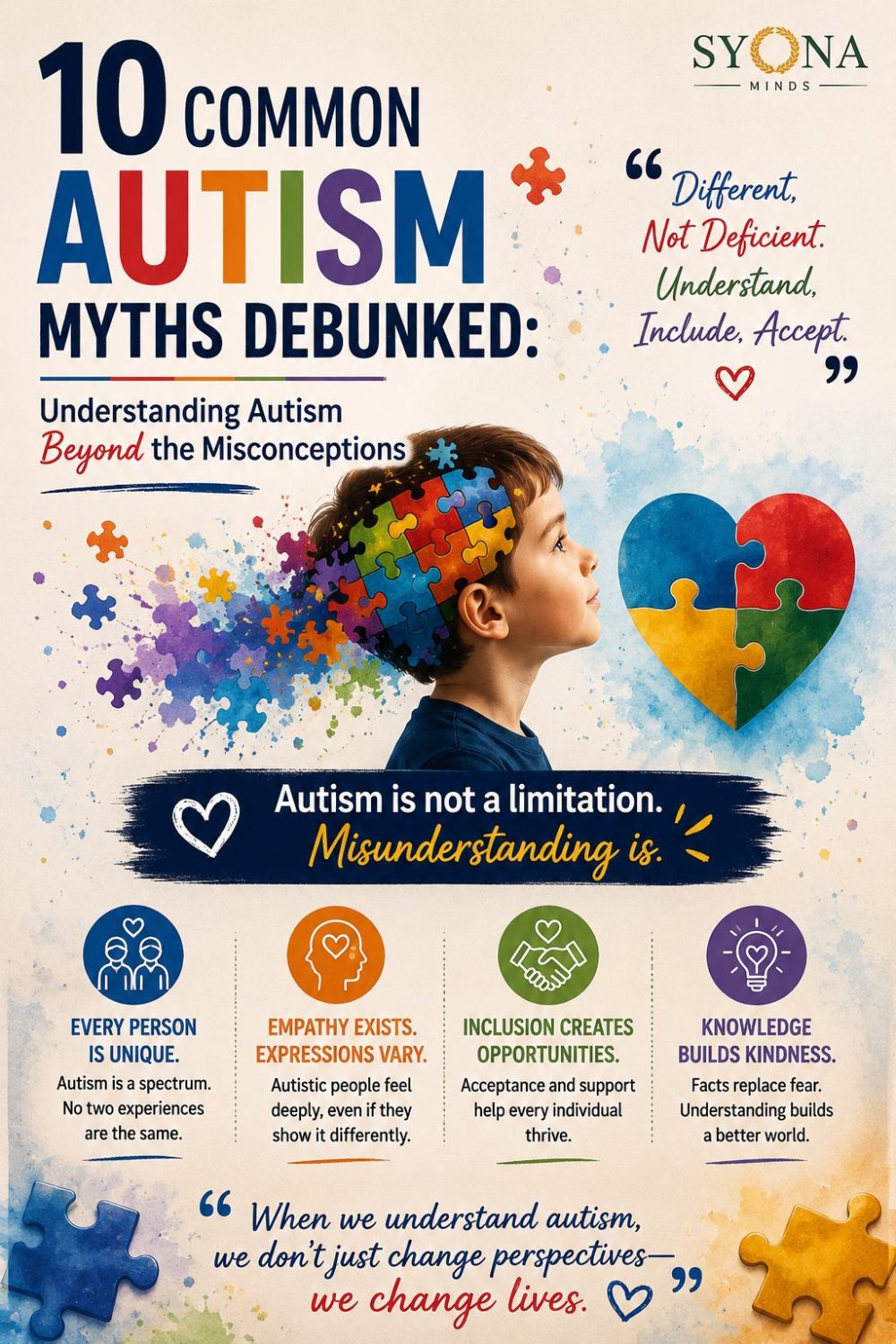
10 Common Autism Myths Debunked
Myth 1: Autistic People Don’t Have Emotions
Perhaps one of the most harmful myths is the belief that autistic individuals lack emotions or empathy.
The Fact
Autistic people experience the full range of human emotions.
In many cases, they feel emotions very deeply.
What may differ is how emotions are expressed or interpreted.
Some autistic individuals may not display facial expressions or body language in ways that others expect.
Others may struggle to identify or describe their emotions verbally.
This does not mean they don’t care.
Psychological Perspective
Research suggests that many autistic individuals experience what’s known as emotional processing differences, rather than emotional absence.
Some actually report experiencing heightened empathy, becoming deeply affected by the emotions of others.
The challenge often lies in interpreting social cues not in feeling compassion.
What You Can Do
Instead of assuming someone lacks emotion, ask respectful questions, allow different communication styles, and avoid judging feelings based solely on facial expressions.
Myth 2: Autism Is Caused by Bad Parenting
Decades ago, an outdated theory suggested that emotionally distant parenting caused autism.
This idea has been completely disproven.
The Fact
Autism is not caused by parenting style.
Extensive scientific research shows that autism develops through a combination of genetic and biological factors that influence early brain development.
Loving, supportive parenting neither causes nor cures autism.
Psychological Perspective
Parents often experience unnecessary guilt after receiving an autism diagnosis.
Removing blame allows families to focus on what truly matters supporting the child’s development and wellbeing.
What You Can Do
Offer encouragement instead of judgment.
Parents need understanding, information, and support not blame.
Myth 3: Vaccines Cause Autism
This myth has persisted despite overwhelming scientific evidence proving otherwise.
The Fact
Large-scale research involving millions of children has consistently shown no link between vaccines and Autism Spectrum Disorder.
The original study that claimed a connection has been thoroughly discredited and retracted due to serious ethical and scientific misconduct.
Vaccines protect children from dangerous infectious diseases and remain one of the safest and most effective public health interventions.
Psychological Perspective
Fear spreads more quickly than facts.
When parents encounter conflicting information online, anxiety can make misinformation seem convincing.
Reliable medical guidance is essential.
What You Can Do
Discuss vaccine questions with qualified healthcare professionals and rely on trusted scientific organizations rather than social media claims.
Myth 4: Every Autistic Person Is a Genius
Movies often portray autistic individuals as mathematical prodigies or people with extraordinary memory.
While some autistic individuals possess exceptional talents, this stereotype does not represent the entire spectrum.
The Fact
Autistic people have a wide variety of abilities, strengths, personalities, and interests.
Some excel academically.
Others struggle with learning.
Many possess remarkable creativity, honesty, attention to detail, artistic ability, or problem-solving skills that may not fit traditional definitions of intelligence.
Every autistic person is unique.
Psychological Perspective
Assuming every autistic person has extraordinary abilities creates unrealistic expectations and overlooks their individual strengths and support needs.
Recognizing each person’s uniqueness promotes healthier self-esteem and more meaningful inclusion.
Myth 5: Autistic Children Will Never Live Independent Lives
Receiving an autism diagnosis can sometimes lead families to fear the future.
Fortunately, this myth overlooks the enormous diversity within the autism spectrum.
The Fact
Many autistic individuals attend university, build successful careers, form meaningful relationships, become parents, and live independently.
Others may require varying levels of support throughout adulthood.
Success should never be measured by independence alone.
Rather, it should be measured by quality of life, wellbeing, meaningful relationships, and opportunities to reach one’s personal potential.
Psychological Perspective
Children thrive when adults focus on strengths rather than limitations.
Providing individualized support, encouraging autonomy, and creating inclusive environments helps autistic individuals build confidence and life skills over time.
Myth 6: Autism Only Affects Children
Many people assume autism is something children “grow out of” as they get older. This misconception often leaves autistic adults feeling invisible and unsupported.
The Fact
Autism is a lifelong neurodevelopmental condition.
Autistic children grow into autistic adults. While many individuals learn coping strategies, improve communication skills, and become more independent over time, autism itself does not disappear.
As adults, autistic individuals may attend college, build successful careers, marry, raise families, or pursue unique passions. Others may continue to need varying levels of support throughout life. Every autistic person’s journey is different.
Psychological Perspective
Many autistic adults report that the biggest challenges they face are not autism itself but misunderstanding, social stigma, and environments that fail to accommodate different needs.
Acceptance and accessibility often make a greater difference than trying to “normalize” autistic behaviors.
How You Can Help
Support autistic individuals throughout every stage of life by promoting inclusive education, accessible workplaces, and respectful community environments.
Myth 7: Autistic People Don’t Want Friends
Because some autistic individuals enjoy spending time alone or communicate differently, people often assume they dislike relationships.
The Fact
Many autistic people deeply value friendship, family, and meaningful relationships.
The challenge often lies in understanding social expectations, interpreting body language, maintaining conversations, or managing overwhelming social environments not in lacking the desire to connect.
Some autistic individuals prefer a few close friendships rather than large social circles, while others enjoy meeting many people.
Psychological Perspective
Social interaction can require significantly more mental effort for autistic individuals. After prolonged social situations, many experience what is known as social fatigue, where the brain becomes exhausted from constantly processing communication and sensory information.
Choosing solitude sometimes reflects the need to recharge not loneliness.
How You Can Help
Allow friendships to develop naturally.
Respect different communication styles and avoid assuming someone is unfriendly simply because they communicate differently.
Myth 8: Autism Looks the Same in Everyone
Perhaps one of the biggest misconceptions is believing there is a single “autistic look” or personality.
The Fact
Autism is called a spectrum because no two autistic people experience it in exactly the same way.
One person may:
- Love conversation.
- Need minimal support.
- Thrive academically.
Another person may:
- Communicate nonverbally.
- Experience significant sensory sensitivities.
- Require daily assistance.
Both are equally autistic.
Girls, women, and many adults are also increasingly being diagnosed later in life because their traits often present differently or have been masked for years.
Psychological Perspective
Individual differences are normal in all human development.
Viewing autism as a spectrum encourages personalised support instead of expecting everyone to fit a single stereotype.
How You Can Help
Get to know the individual instead of relying on assumptions.
If you’ve met one autistic person, you’ve met one autistic person not the entire autism community.
Myth 9: Autistic People Can’t Communicate
Communication differences are often misunderstood as an inability to communicate.
The Fact
Autistic individuals communicate in many different ways.
Some communicate verbally.
Others use:
- Sign language
- Picture communication systems
- Tablets or communication devices
- Written communication
- Gestures
Communication is much broader than spoken language.
Many autistic individuals who speak fluently may still find it difficult to express emotions during stressful situations.
Psychological Perspective
Communication challenges often result from differences in processing language, sensory information, or social expectations not from a lack of intelligence.
Providing alternative communication methods can dramatically improve confidence and independence.
How You Can Help
Be patient.
Allow extra processing time.
Respect alternative communication methods rather than insisting on spoken language alone.
Myth 10: Autism Needs to Be “Fixed”
This misconception can unintentionally send the message that autistic individuals are somehow “broken.”
The Fact
Autism is not something that needs to be erased.
Support focuses on helping autistic individuals develop communication skills, independence, emotional wellbeing, and quality of life while respecting their unique identities.
Many autistic adults describe autism as an important part of who they are rather than something separate from themselves.
The goal is not to make autistic people appear “less autistic.”
The goal is to help them thrive.
Psychological Perspective
Modern psychology increasingly embraces a neurodiversity-affirming approach, recognising that different brain styles contribute valuable perspectives, creativity, innovation, and problem-solving abilities.
Acceptance improves mental health far more effectively than forcing conformity.
How You Can Help
Celebrate strengths while providing support where needed.
Focus on understanding, inclusion, and opportunity rather than changing someone’s identity.
How Families, Schools, and Communities Can Support Autistic Individuals
Supporting autistic people begins with understanding.
Small changes in everyday interactions can create a significant difference.
1. Listen to Autistic Voices
Whenever possible, learn directly from autistic individuals about their experiences rather than relying solely on stereotypes or assumptions.
Their lived experiences provide valuable insight.
2. Create Sensory-Friendly Environments
Bright lights, loud sounds, crowded spaces, or strong smells can become overwhelming.
Simple adjustments such as quiet spaces, noise-reducing headphones, or flexible lighting can greatly improve comfort.
3. Respect Different Communication Styles
Not everyone communicates the same way.
Allow additional processing time, avoid interrupting, and recognise that eye contact or body language may differ from neurotypical expectations.
4. Focus on Strengths
Autistic individuals often possess remarkable qualities such as:
- Creativity
- Attention to detail
- Honesty
- Loyalty
- Deep knowledge of interests
- Strong memory
- Innovative thinking
Building upon strengths promotes confidence and independence.
5. Promote Acceptance Instead of Awareness Alone
Awareness helps people recognise autism.
Acceptance creates environments where autistic individuals feel respected, included, and valued.
True inclusion goes beyond understanding; it involves meaningful participation.
Common Mistakes to Avoid
Even well-meaning people sometimes unintentionally create barriers.
Avoid these common mistakes:
Speaking About Someone Instead of With Them
Whenever appropriate, include autistic individuals directly in conversations that affect them.
Assuming Every Difficulty Is Caused by Autism
Like everyone else, autistic individuals have unique personalities, preferences, strengths, and challenges beyond their diagnosis.
Expecting Eye Contact
Some autistic people find eye contact uncomfortable or distracting.
Listening does not always look the same.
Using Outdated Language
Many people prefer identity-first language such as “autistic person,” while others prefer “person with autism.”
Respect each individual’s preference whenever possible.
Comparing Autistic Individuals
Every autistic person develops differently.
Avoid comparisons and celebrate individual progress.
Key Takeaways
✔ Autism is a neurodevelopmental difference not a disease.
✔ Every autistic individual is unique.
✔ Scientific evidence shows vaccines do not cause autism.
✔ Autistic people experience emotions, relationships, empathy, and personal growth.
✔ Early understanding and appropriate support improve long-term wellbeing.
✔ Acceptance, inclusion, and respect benefit autistic individuals far more than stereotypes.
✔ Small acts of empathy can create lifelong positive change.
Frequently Asked Questions
What causes Autism Spectrum Disorder?
Current research suggests autism develops through a combination of genetic and biological factors affecting early brain development. There is no evidence that parenting style or vaccines cause autism.
Can autistic people live independently?
Many autistic adults live independently, work successfully, attend university, and raise families. Others may require varying levels of support. Independence looks different for everyone.
Can autism be diagnosed in adulthood?
Yes.
Many adults receive an autism diagnosis later in life, particularly women and individuals who learned to mask their autistic traits during childhood.
How can I support an autistic family member or friend?
Listen without judgment, respect different communication styles, be patient, create supportive environments, and focus on strengths rather than limitations.
Conclusion
Autism has always existed.
What has changed is our understanding of it.
For many years, myths and stereotypes shaped public opinion, often leading to misunderstanding and unnecessary stigma. Today, research paints a far more accurate picture one that recognises autism as a natural variation in how the brain develops and experiences the world.
Every autistic individual has their own strengths, interests, challenges, and goals. Some communicate through speech, others through technology or gestures. Some thrive in busy social environments, while others prefer calm, predictable spaces. None of these differences make a person less capable of living a meaningful and fulfilling life.
As families, educators, employers, and communities, we all play a role in creating environments where autistic individuals feel accepted rather than judged. That begins with replacing outdated myths with compassion, curiosity, and evidence-based understanding.
When we move beyond misconceptions, we don’t just improve the lives of autistic individuals we create a more inclusive world for everyone.
Understanding autism isn’t about changing autistic people.
It’s about changing the way society understands autism.
References
American Psychiatric Association. (2022). Diagnostic and Statistical Manual of Mental Disorders (5th ed., text rev.).
Centers for Disease Control and Prevention. (2025). Autism Spectrum Disorder (ASD). https://www.cdc.gov/autism
National Institute of Mental Health. (2024). Autism Spectrum Disorder.
World Health Organization. (2023). Autism.
American Academy of Pediatrics. (2020). Identification, Evaluation, and Management of Children With Autism Spectrum Disorder.
Bandura, A. (1977). Social Learning Theory. Prentice Hall.
Fletcher-Watson, S., & Happé, F. (2019). Autism: A New Introduction to Psychological Theory and Current Debate.