Summary
The bond between a child and their caregiver is one of the most influential relationships they will ever experience. Long before children learn to speak, they communicate through eye contact, crying, smiling, and physical closeness, gradually building trust in the people who consistently respond to their needs. These early interactions form the foundation of attachment, a psychological bond that shapes emotional security, social skills, confidence, and lifelong relationships.
Research in developmental psychology has consistently shown that children who develop secure attachments are more likely to regulate their emotions effectively, build healthy relationships, explore the world confidently, and cope with challenges throughout life. Conversely, inconsistent, neglectful, or frightening caregiving can contribute to insecure attachment patterns that may affect emotional wellbeing and interpersonal relationships later in life.
Fortunately, secure attachment isn’t about being a perfect parent. It’s about being consistently responsive, emotionally available, and willing to repair misunderstandings when they occur. Everyday moments comforting a crying baby, listening without judgment, playing together, or validating a child’s emotions can strengthen the parent-child bond in meaningful ways.
In this article, we’ll explore what attachment in childhood development really means, why it matters for infants and young children, and ten evidence-based ways parents and caregivers can build secure attachment that supports lifelong emotional resilience and healthy development.
Introduction
Every child enters the world with one essential question:
“Can I trust the people who care for me?”
The answer isn’t communicated through words. It’s communicated through thousands of everyday interactions.
When a baby cries and someone gently comforts them…
When a toddler falls and a caregiver offers reassurance…
When a child feels frightened and knows they have a safe place to turn…
They begin developing something psychologists call secure attachment.
Attachment is much more than affection.
It forms the emotional blueprint children use to understand themselves, others, and the world around them. It influences how they manage emotions, build friendships, respond to stress, and even approach future romantic relationships.
Parents often worry that they must always respond perfectly to their child. Thankfully, attachment research tells us otherwise. Children don’t need perfect caregivers.
They need caregivers who are consistently loving, emotionally available, and willing to reconnect after difficult moments.
Understanding attachment can help parents feel more confident in supporting not only their child’s early development but also their lifelong emotional wellbeing.
What Is Attachment in Childhood Development?
Attachment in childhood development refers to the deep emotional bond that develops between a child and their primary caregiver during the first years of life.
This relationship provides children with a sense of:
- Safety
- Security
- Trust
- Comfort
- Emotional regulation
Through repeated experiences of responsive caregiving, children gradually learn important beliefs such as:
- “Someone will help me when I’m distressed.”
- “My feelings matter.”
- “I am worthy of love.”
- “The world is generally safe.”
These beliefs become part of what psychologists call an internal working model, the mental framework children use to understand relationships throughout life.
Attachment isn’t formed through expensive toys or elaborate parenting techniques.
It develops through everyday moments of consistent care, responsiveness, and emotional connection.
Understanding Attachment Theory
The modern understanding of attachment comes largely from the pioneering work of psychiatrist John Bowlby and developmental psychologist Mary Ainsworth.
Bowlby proposed that attachment is an evolutionary survival mechanism. Human babies are born highly dependent on caregivers, and forming close emotional bonds increases their chances of survival and healthy development.
Ainsworth later expanded this work through the famous “Strange Situation” studies, identifying different attachment styles based on how children responded to brief separations and reunions with their caregivers.
Researchers generally describe four primary attachment patterns:
Secure Attachment
Children feel safe exploring their environment because they trust that caregivers will return and provide comfort when needed.
These children generally:
- Seek comfort when distressed.
- Recover from stress more easily.
- Explore confidently.
- Develop healthy self-esteem.
- Build positive relationships.
Anxious (Ambivalent) Attachment
- Children become highly distressed during separation and may struggle to feel reassured even after caregivers return.
- They often seek closeness but remain uncertain about caregiver availability.
Avoidant Attachment
- Children appear independent but may suppress emotional needs because they have learned that comfort is not consistently available.
- They often avoid seeking help even when distressed.
Disorganized Attachment
- Children display inconsistent or confusing behaviors toward caregivers, often associated with frightening, unpredictable, or traumatic caregiving experiences.
- Early intervention can significantly improve outcomes.
Why Is Secure Attachment So Important?
Secure attachment influences nearly every area of child development.
1. Supports Healthy Brain Development
During infancy, the brain develops at an extraordinary rate.
Responsive caregiving helps strengthen neural pathways involved in:
- Emotional regulation.
- Memory.
- Language.
- Learning.
- Stress management.
Positive early relationships literally shape the developing brain.
2. Builds Emotional Security
Children who feel emotionally safe are more willing to:
- Express feelings.
- Ask for help.
- Try new experiences.
- Recover from setbacks.
Knowing someone is consistently available provides a secure emotional foundation.
3. Encourages Independence
Many parents assume that close attachment creates dependence.
Research suggests the opposite. Children who feel securely attached often become more independent because they have a trusted “secure base” from which to explore the world.
4. Strengthens Future Relationships
Secure attachment teaches children how healthy relationships work.
They learn:
- Trust.
- Empathy.
- Communication.
- Cooperation.
- Emotional closeness.
These skills continue influencing friendships, family relationships, and romantic partnerships throughout adulthood.
5. Improves Resilience
- Life inevitably includes disappointments and challenges.
- Children with secure attachments often cope more effectively because they have learned that difficult emotions can be managed with support.
Signs of Secure and Insecure Attachment
Every child is unique, but certain patterns may indicate how attachment is developing.
Signs of Secure Attachment
Children may:
- Seek comfort when upset.
- Return to play after reassurance.
- Show curiosity and confidence.
- Express emotions openly.
- Make eye contact.
- Enjoy physical affection.
- Build healthy friendships.
- Trust caregivers.
Possible Signs of Insecure Attachment
Some children may:
- Avoid seeking comfort.
- Become extremely distressed during separation.
- Show difficulty calming down.
- Withdraw emotionally.
- Display excessive clinginess.
- Struggle with emotional regulation.
- Have difficulty trusting others.
These behaviours do not automatically indicate an attachment disorder. Many factors, including temperament, developmental stage, stress, and life circumstances, can influence a child’s behaviour. If concerns persist, consulting a paediatrician or child psychologist can provide guidance.
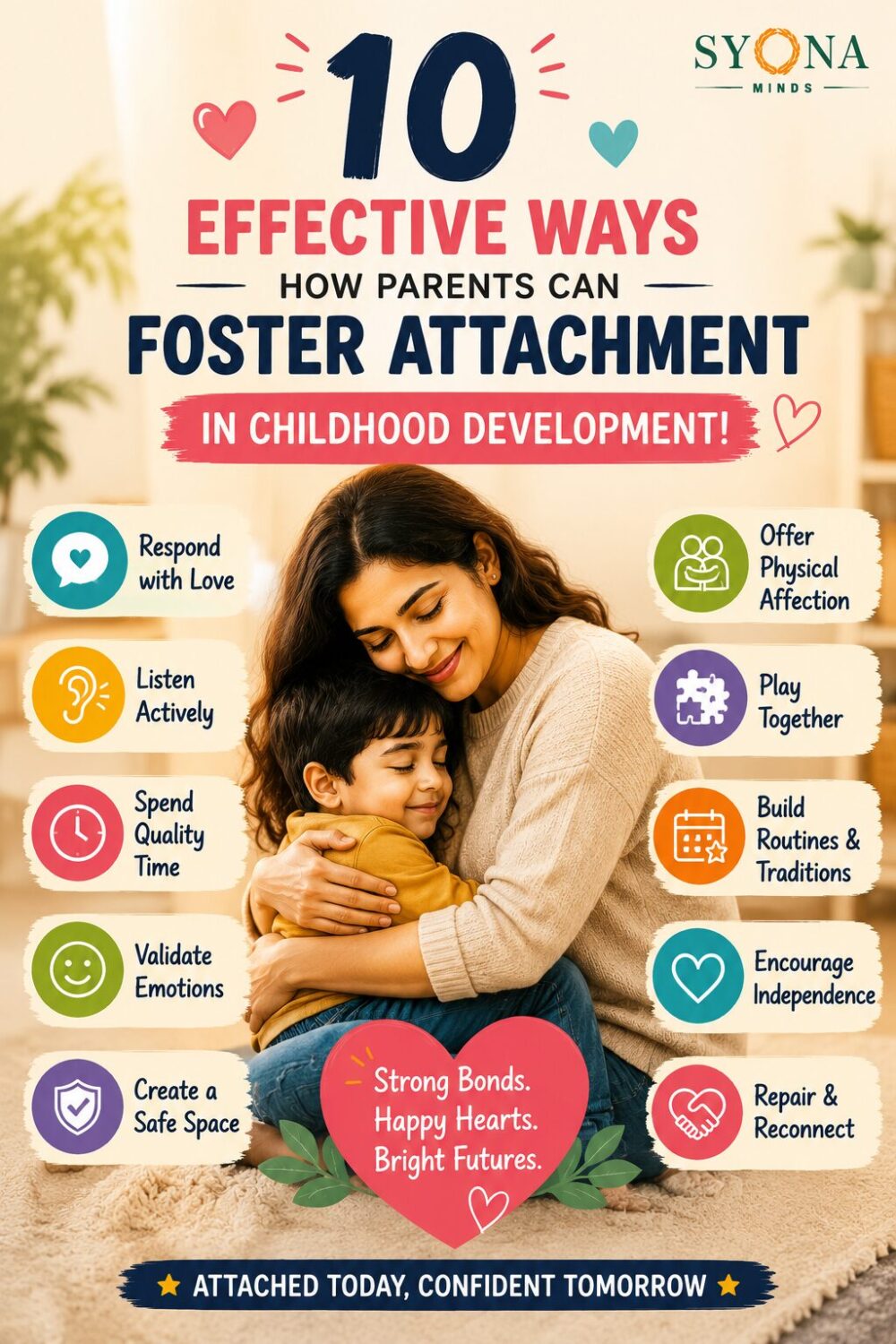
10 Powerful Ways to Build Secure Attachment
1. Respond Consistently to Your Child’s Needs
One of the strongest predictors of secure attachment is consistent responsiveness. This doesn’t mean responding perfectly every single time. It means being emotionally available and making genuine efforts to understand your child’s needs.
For infants, responsiveness might include:
- Feeding when hungry.
- Comforting when crying.
- Smiling during interactions.
- Making eye contact.
- Speaking in a soothing voice.
For older children, responsiveness may involve:
- Listening without interrupting.
- Offering comfort after disappointment.
- Taking emotions seriously.
- Helping solve problems together.
Why It Matters
When children repeatedly experience reliable care, they begin believing:
“When I need someone, someone will be there.”
This belief becomes the cornerstone of lifelong emotional security.
2. Practice Emotion Coaching
Children aren’t born knowing how to understand or regulate emotions. Parents play an important role in teaching these skills. Instead of dismissing difficult feelings, help your child identify and name them.
For example:
“It looks like you’re feeling frustrated because the puzzle isn’t fitting together.”
Follow with reassurance and problem-solving.
Emotion coaching helps children learn that all feelings are acceptable even when certain behaviors are not.
Why It Matters
Children who understand emotions are generally better at managing stress, resolving conflicts, and developing empathy toward others.
3. Spend Quality Time Without Distractions
Attachment grows through meaningful interaction, not necessarily long hours together.
Set aside dedicated time each day to focus entirely on your child.
Ideas include:
- Reading together.
- Playing imaginative games.
- Going for walks.
- Drawing or building together.
- Talking during bedtime.
During this time, put away phones and other distractions.
Your full attention sends a powerful message:
“You matter to me.”
4. Accept Your Child’s Individual Personality
Every child has a unique temperament. Some are outgoing and adventurous. Others are cautious, sensitive, or quiet.
Rather than trying to change your child’s personality, aim to understand and support it.
Celebrate their strengths while gently guiding them through challenges.
Children who feel accepted develop stronger self-esteem and greater emotional security.
5. Create Predictable Daily Routines
Young children feel safest when life has a sense of consistency.
Simple routines such as regular mealtimes, bedtime rituals, and family traditions create predictability and reduce anxiety.
Routines also provide opportunities for connection, such as reading bedtime stories or sharing meals together.
Why It Matters
Consistency helps children trust that their needs will be met, reinforcing feelings of safety and stability.
6. Be Emotionally Available During Difficult Moments
Children don’t remember every toy they receive or every outing they enjoy, but they do remember how safe they felt when they were scared, sad, or overwhelmed.
Being emotionally available means helping your child navigate difficult emotions rather than avoiding or dismissing them.
When your child is upset:
- Stay calm and patient.
- Listen without interrupting.
- Acknowledge their feelings before offering solutions.
- Provide physical comfort if they seek it.
- Reassure them that emotions are temporary and manageable.
For example, instead of saying:
“Stop crying, it’s not a big deal.”
Try:
“I can see you’re really upset. I’m here with you, and we’ll figure it out together.”
Why It Matters
When children learn that difficult emotions are met with understanding rather than criticism, they develop healthier emotional regulation skills and a stronger sense of security.
7. Encourage Play and Shared Experiences
Play is one of the most natural ways children build relationships.
Whether you’re playing pretend, building blocks, drawing pictures, or kicking a ball around, these moments strengthen emotional bonds while helping children feel seen and valued.
Simple ideas include:
- Reading stories together.
- Cooking as a family.
- Nature walks.
- Arts and crafts.
- Board games.
- Building puzzles.
- Dancing to music.
- Gardening.
During play, allow your child to lead sometimes. Follow their ideas and engage with curiosity instead of directing every activity.
Why It Matters
Play creates positive emotional memories, strengthens communication, and reinforces the message that spending time together is enjoyable and meaningful.
8. Model Healthy Relationships
Children learn far more from what they observe than from what they’re told.
The way adults handle emotions, disagreements, affection, and respect becomes a child’s first lesson in relationships.
Model behaviors such as:
- Speaking respectfully.
- Apologizing after mistakes.
- Managing frustration calmly.
- Listening attentively.
- Showing kindness to others.
- Expressing gratitude.
If conflict occurs at home, let children see healthy repair as well.
For example:
“I’m sorry I raised my voice earlier. I was frustrated, but I shouldn’t have spoken that way.”
Why It Matters
Children learn that healthy relationships include mistakes, forgiveness, communication, and mutual respect not perfection.
9. Create Family Rituals and Traditions
Predictable family traditions help children feel connected and emotionally secure.
These traditions don’t have to be elaborate.
Simple rituals might include:
- Friday movie nights.
- Bedtime stories.
- Sunday breakfasts together.
- Birthday traditions.
- Family gratitude conversations.
- Evening walks.
- Holiday baking.
Over time, these routines become emotional anchors that reinforce belonging and stability.
Why It Matters
Family traditions create positive shared memories and strengthen a child’s sense of identity, belonging, and security.
10. Repair After Conflict
No parent responds perfectly every time.
Everyone loses patience occasionally.
The good news is that repairing relationships after conflict is just as important as avoiding conflict altogether.
If you’ve had a difficult interaction:
- Calm yourself first.
- Acknowledge what happened.
- Apologize sincerely if appropriate.
- Reassure your child that your love hasn’t changed.
- Discuss how to handle similar situations differently next time.
For example:
“I was feeling stressed earlier, and I shouldn’t have shouted. I’m sorry. I love you, and let’s talk about what happened together.”
Why It Matters
Repair teaches children that relationships can recover after misunderstandings. This builds trust, resilience, forgiveness, and emotional security.
Common Parenting Habits That Can Weaken Attachment
Attachment develops through consistent emotional connection, but certain habits may unintentionally interfere with that bond.
Being Emotionally Unavailable
- Parents can be physically present while emotionally distracted.
- Constant multitasking, excessive phone use, or consistently dismissing a child’s attempts to connect may leave children feeling unseen.
- Aim to provide moments of focused attention every day.
Ignoring or Minimizing Emotions
Statements like:
- “Stop crying.”
- “You’re overreacting.”
- “There’s nothing to be upset about.”
can unintentionally teach children that their emotions aren’t important.
Instead, validate their feelings before helping them solve problems.
Using Fear as Discipline
- While clear boundaries are important, discipline based primarily on fear, threats, or humiliation can damage trust.
- Children learn best when discipline is calm, respectful, and focused on teaching rather than punishment.
Expecting Perfection
- Children need to know that love isn’t conditional upon behavior, achievements, or success.
- Celebrate effort, resilience, kindness, and progress not just outcomes.
The Role of Fathers, Grandparents, and Other Caregivers
Although attachment research often focuses on mothers, children can develop secure attachments with multiple caring adults.
Fathers
Research shows that involved fathers contribute significantly to children’s:
- Emotional regulation.
- Confidence.
- Social competence.
- Problem-solving skills.
- Independence.
Through play, conversation, affection, and consistent caregiving, fathers become important attachment figures.
Grandparents
Grandparents often provide:
- Emotional stability.
- Family traditions.
- Cultural values.
- Practical support.
- Unconditional encouragement.
Strong grandparent relationships can strengthen a child’s overall sense of belonging.
Teachers and Caregivers
Children also benefit from secure relationships with:
- Teachers.
- Childcare providers.
- Coaches.
- Extended family members.
Consistent, caring adults help reinforce emotional security across different environments.
The Lifelong Benefits of Secure Attachment
The effects of secure attachment extend well beyond childhood.
Research suggests securely attached individuals are more likely to:
- Develop healthy friendships.
- Build satisfying romantic relationships.
- Manage stress effectively.
- Show greater empathy.
- Perform better academically.
- Demonstrate higher self-esteem.
- Develop resilience during adversity.
- Seek help when needed.
- Communicate effectively.
- Experience greater overall wellbeing.
While early attachment is incredibly important, it’s also encouraging to know that relationships remain capable of healing and strengthening throughout life.
Warm, consistent caregiving at any stage can promote healthier attachment patterns.
Key Takeaways
✔ Secure attachment forms through consistent, responsive, and emotionally available caregiving.
✔ Children don’t need perfect parents they need parents who repair, reconnect, and respond with empathy.
✔ Everyday moments such as play, conversation, affection, and routines build lasting emotional security.
✔ Healthy attachment supports brain development, confidence, resilience, and lifelong relationships.
✔ Fathers, grandparents, teachers, and other caregivers all contribute to secure attachment.
✔ Strong early relationships provide children with a foundation for emotional wellbeing throughout life.
Frequently Asked Questions (FAQs)
What is secure attachment in childhood development?
Secure attachment is a trusting emotional bond between a child and a caregiver. It develops when caregivers consistently respond with warmth, sensitivity, and reliability, helping children feel safe, valued, and confident exploring the world.
Why is attachment important during infancy?
During infancy, secure attachment supports healthy brain development, emotional regulation, stress management, and the development of trust. These early experiences influence relationships and emotional wellbeing throughout life.
Can attachment improve if early experiences were difficult?
Yes. Although early experiences are important, attachment is not fixed. Consistent, nurturing, and emotionally responsive relationships later in childhood can strengthen attachment and promote healing.
Can children have more than one secure attachment?
Absolutely. Children often develop secure attachments with fathers, grandparents, teachers, childcare providers, and other trusted adults who provide consistent care and emotional support.
How can busy parents strengthen attachment every day?
Simple daily interactions make a significant difference. Reading together, listening attentively, sharing meals, offering hugs, validating emotions, playing, and maintaining predictable routines all strengthen the parent-child bond.
Conclusion
Attachment is not built through grand gestures or expensive gifts it is created in the ordinary moments of everyday life. Every comforting hug, bedtime story, shared laugh, patient conversation, and reassuring response helps children develop a deep sense of trust and emotional security. These repeated experiences teach them that they are loved, valued, and worthy of care.
As children grow, secure attachment becomes the foundation upon which they build confidence, resilience, healthy relationships, and emotional wellbeing. It gives them the courage to explore the world, recover from setbacks, and seek support when life becomes challenging. Even when mistakes happen as they inevitably do in every family repairing those moments with honesty, empathy, and connection strengthens the relationship rather than weakens it.
It’s important to remember that secure attachment is not about being a perfect parent. It is about showing up consistently, responding with compassion, and creating an environment where children feel emotionally safe. Small, everyday acts of love and understanding often have a greater impact than occasional grand efforts.
At Syona Minds, we believe that nurturing secure attachment is one of the greatest investments parents and caregivers can make in a child’s future. By fostering trust, emotional connection, and unconditional support from the earliest years, we help children develop the confidence and resilience they need to flourish not only throughout childhood but across every stage of life.
References
1. Ainsworth, M. D. S., Blehar, M. C., Waters, E., & Wall, S. (1978). Patterns of Attachment: A Psychological Study of the Strange Situation. Lawrence Erlbaum Associates.
2. Bowlby, J. (1988). A Secure Base: Parent-Child Attachment and Healthy Human Development. Basic Books.
3. Center on the Developing Child at Harvard University. (2021). Serve and Return Interaction Shapes Brain Architecture.
4. National Scientific Council on the Developing Child. (2020). Connecting the Brain to the Rest of the Body: Early Childhood Development and Lifelong Health.
5. Siegel, D. J., & Bryson, T. P. (2016). The Whole-Brain Child. Bantam Books.
6. World Health Organisation. (2023). Nurturing Care for Early Childhood Development.